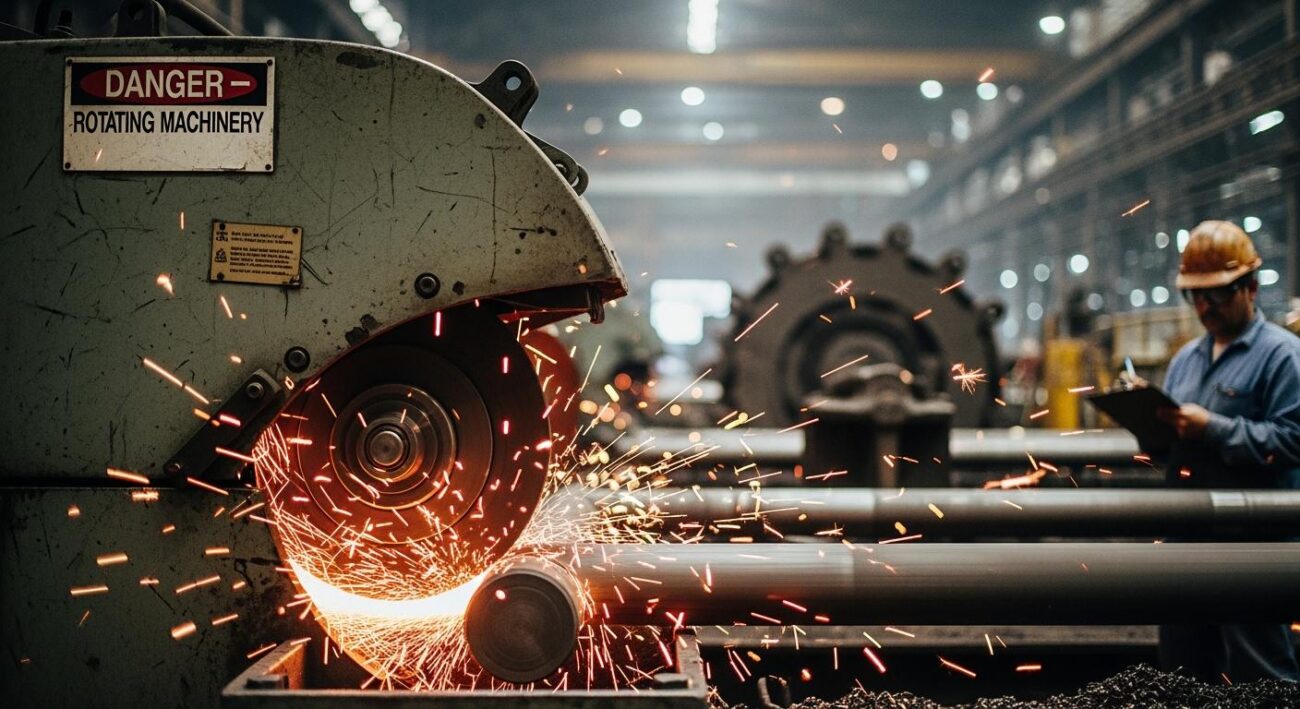
Why Grinding Wheels Stop Cutting — Even After You Change Them
You mount one wheel after another, and the wheel still will not cut. The sparks shrink, the sound turns dull, the part runs hot, and no matter how you push, the feed will not go in. So you change the abrasive, the grit, the hardness, the bond — and after a whole round of trials, it still will not cut.
Here is the question to ask first: did you actually change the specification, or did you only switch brands or suppliers? Those are not the same thing. A wheel that will not cut is usually a selection problem, not a quality problem. This guide walks through the six checks — and the two blind spots almost everyone misses.
Check 1: Sort the Three Kinds of “Won’t Cut” Apart
Troubleshooting does not start with a new wheel. It starts with reading the symptom. These three conditions look alike on the surface, but their mechanisms are opposite — treat the wrong one and you usually make things worse.
| Condition | Wheel Face | Mechanism | Direction |
|---|---|---|---|
| Glazing | Clean but shiny, no swarf | Grit tips flattened; bond holds too tightly; dull grains cannot fall out | Dress + drop hardness + open up with a stick |
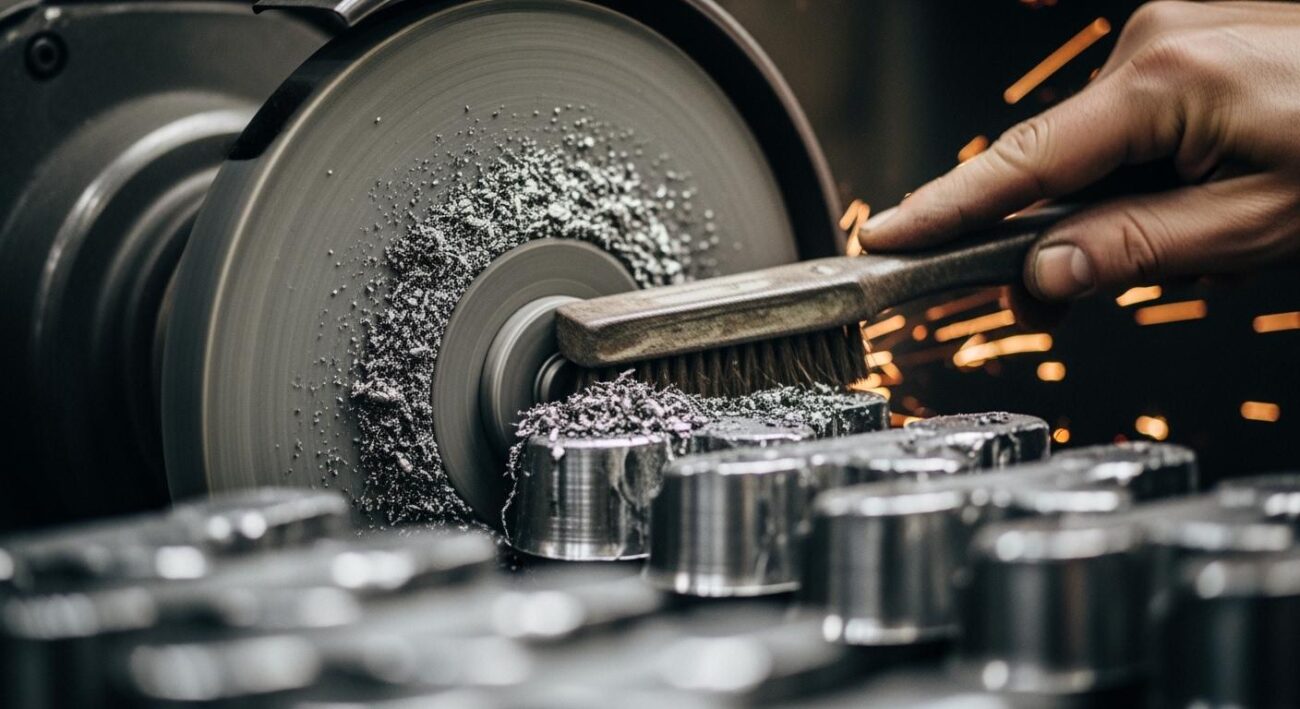
| Loading | Dark, swarf packed in the pores | Chips stuck in pores; coolant cannot reach; heat has nowhere to go | Open structure + improve coolant + raise concentration |
| End of life | Sudden failure after long steady service | Superabrasive layer thin; metal core starts touching the workpiece | Replace — physical limit, not a defect |
Glazing: the sparks shrink, the sound turns dull, and the workpiece turns bright and hot. The wheel grinds more and more like a smooth stone, squeezing over the part instead of cutting.
Loading: looks a lot like glazing. The quick way to tell them apart is the color of the wheel face — glazing leaves it clean and shiny, loading leaves it dark with swarf packed in.
End of life applies mostly to superabrasive wheels — CBN and diamond — whose abrasive layer is thin. When only 1–2 mm of abrasive layer is left, the metal core starts touching the workpiece and friction jumps. That is a physical limit of the construction, not a quality defect. Replacing the wheel is the most economical fix.
Expert Tip: The fastest check is the wheel face color. Clean and shiny means glazing; dark and packed means loading; both look the same from across the shop but the fixes are opposite. Glazing wants a softer wheel or more dressing; loading wants more pores and better coolant.
Check 2: Hardness and Abrasive — the Two Most Common Selection Traps
Hardness: Harder Workpiece, Softer Wheel
Many people assume hard workpieces need hard wheels. It is the opposite: the harder the workpiece, the softer the wheel should be.
When the work is hard, grains blunt fast on the surface. If the wheel is hard as well, the dull grains cannot shed, and the wheel fills with dull edges and tires faster and faster. The right move is a bond that holds a little less firmly, so dull grains drop out in time and fresh ones underneath take over.
| Workpiece | Typical Grade |
|---|---|
| Soft steel (unhardened, below HRC 20) | F–H |
| Structural and alloy steel | J–K |
| Hardened steel (above HRC 55) | J or softer |
| Die steel, high-speed steel, bearing steel | J–K |
| Stainless and gummy materials | J, softer side, with open structure |
A quick field test of whether the grade is right: excessive wheel wear and poor form retention mean too soft; burn, blue discoloration, or loading means too hard.
Abrasive: The Most Expensive Trap
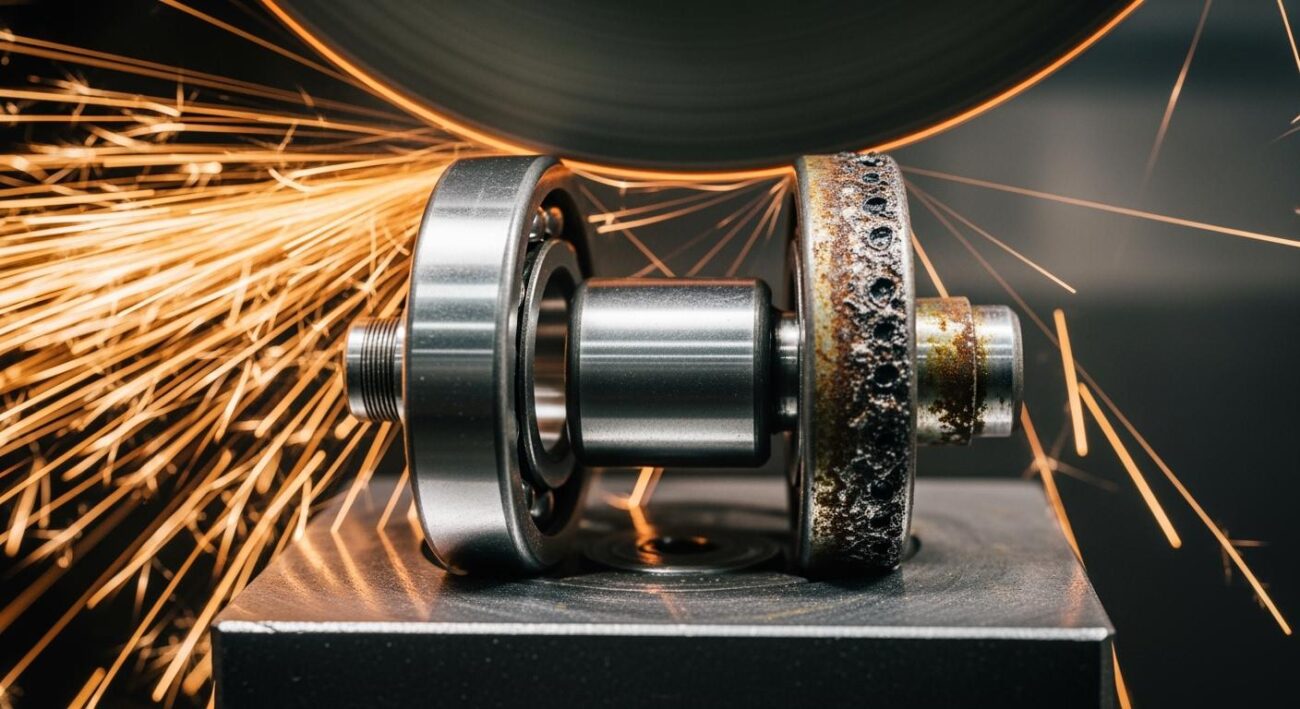
Diamond cannot grind steel. Above roughly 800°C, diamond carbonizes against iron and the abrasive layer burns away fast. Many customers hear that diamond is the hardest abrasive and mount it on GCr15 or die steel — with the result that the wheel cannot cut the work, and the money burns away with the abrasive. Iron-based materials need CBN (cubic boron nitride).
Gummy workpieces need a different abrasive too. White fused alumina (WA) loads up and sticks on stainless steel. Switch to single-crystal alumina (SA) or microcrystalline alumina, and for really gummy jobs go straight to CBN.
CBN is the correct answer for hardened steel. Bearing steel and die steel above HRC 60 see CBN life 10–50 times that of alumina, with G-ratio a hundred times higher or more. The unit price runs 30–50% higher, but total cost is often lower — fewer dressings, higher efficiency, no burned scrap.
The fundamental rule: the hardest abrasive is not the most universal one. Iron-based materials use CBN. Non-ferrous materials — carbide, ceramic, glass, stone — use diamond. Steel uses alumina. Getting this backwards wastes both the wheel and the workpiece.
Expert Tip: “Harder workpiece, softer wheel” and “diamond is not universal” are the two rules that catch the most selection mistakes. Both feel backwards at first, and both are true in the field.
Check 3: Grit, Structure, and Bond — Three Variables That Move Together
Each one can look right on its own and still be wrong in combination. If any of these three disagrees with the hardness and abrasive from Check 2, the wheel is likely to be “born not cutting” again.
Grit Size Follows Stock Removal
Roughing with big stock calls for coarse grit (46–60), with wide spaces between grains for free chip flow. Fine grit (80–120 and up) is for the finishing passes that chase surface finish.
The real trap is not picking them the wrong way round — nobody finishes with a roughing wheel. It is trying to make one pass do two jobs: stock that is really roughing allowance, removed by a fine-grit wheel expected to cut it all at once. Fine grit means small pores; heavy chips cannot get out; the wheel loads up pass after pass and loses power.
Structure Number Means Porosity
Gummy materials — stainless steel and titanium — need an open structure, grades 7–9: room for the chips, and coolant that can actually reach the grinding zone. A dense structure belongs to finishing — sharper, better finish, but small chip space and quick loading.
Large stock removal also wants an open structure — big chips need big chip room. Small stock and finishing want a tighter structure, chasing sharpness and surface quality.
Bond Type Determines Self-Sharpening and Speed Ceiling
| Bond | Characteristics | Application | Speed Ceiling |
|---|---|---|---|
| Vitrified (V) | Porous, good cooling, self-sharpening | General purpose, most common | 35–45 m/s |
| Resinoid (B) | Elastic, good polishing | Finishing, tool grinding | 35 m/s |
| Metal (M) | High strength, good form retention | CBN and diamond wheels | 80 m/s |
| Electroplated (P) | Single layer, high efficiency | Complex profiles, small batches | 120 m/s |
Choose the wrong bond and both your dressing method and your speed ceiling go wrong with it. Vitrified wheels chasing 50 m/s, or resinoid wheels doing heavy roughing, are typical selection errors.
Metal bond is strong and serves CBN and diamond, but self-sharpening depends entirely on external dressing. Without dressing, it is essentially a superabrasive wheel that has loaded up — “won’t cut” is almost inevitable. Electroplated is single-layer and cannot be dressed; when it dulls, it is done.
Expert Tip: The most common misapplication is using a fine-grit wheel to remove roughing allowance. If the stock is a roughing amount, use a roughing wheel. No amount of parameter tuning will make a fine-grit wheel evacuate roughing-size chips.
Check 4: Dressing — Truing Is Not Enough, You Have to Condition
Does the right selection guarantee the wheel will cut? Not necessarily. Dress it wrong and it still will not cut.
Here is a detail most people miss: dressing is really two jobs — truing and conditioning. Truing makes the wheel round, flat, and in profile; almost everyone does this one. But truing without conditioning is wasted work.
This matters most for vitrified CBN: after truing, the face carries a film of bond that seals the grains. Press a green silicon-carbide dressing stick on it lightly for 30–60 seconds to wear that film away and expose sharp edges. Metal-bond CBN needs electrolytic conditioning — an ordinary stick will not touch it. Skip these steps and the wheel goes onto the machine as a dull knife.
A simple test: after dressing, run a finger lightly over the face. A prickly, gritty feel means it is truly conditioned; a smooth feel means it was trued but never opened up.
How Often to Dress
There is no fixed piece count — it follows the stock per part. Grinding stainless, one part may give up 0.3 mm while another is finished with only 0.03 mm; the wheel dulls an order of magnitude faster in the first case. A wheel like that may need dressing every few parts; the finishing wheel can run dozens of parts without it.
Stop memorizing counts and watch the signals — sparks shrinking, the sound turning dull, the surface turning bright and hot: it is time to dress. Gummy materials send these signals fast, so keep an eye on them. Stretch the interval too long, the dull layer builds up, and the wheel slides from “weak” into “will not cut.”
Expert Tip: If the wheel feels smooth after dressing, you trued it but did not condition it. The grain edges are still buried under bond. Thirty seconds with a dressing stick makes the difference between a cutting wheel and a rubbing wheel.
Check 5: Coolant Concentration — Not Just Filtration
Last time, in the scratches guide, the coolant topic was filtration: a magnetic separator cannot catch alumina grains, and the filter should hold 10–15 microns. This time, the subject is concentration.
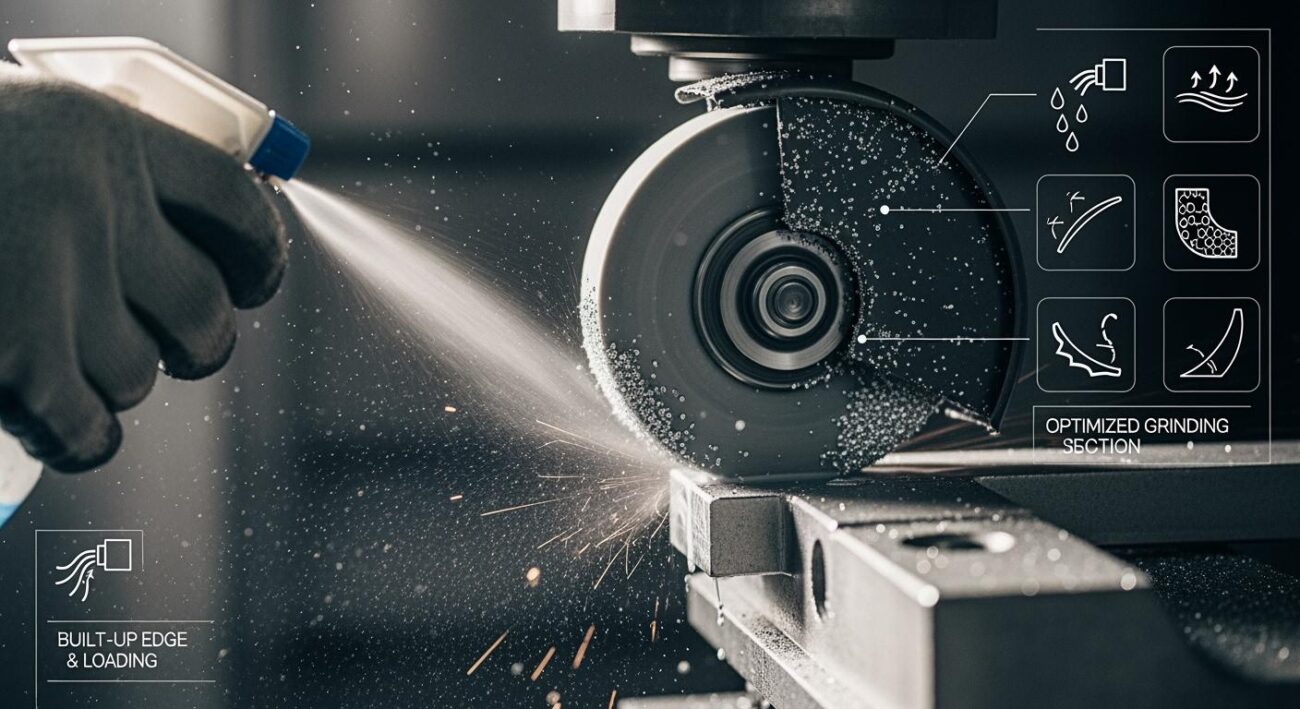
Too low — below 3%: not enough lubricant, swarf sticks to the wheel and loads it up, the zone runs hot and the grains wear fast. That “won’t cut” is the wheel being blocked by chips.
Too high — above 10%: over-lubrication. The grains slide over the work instead of cutting. That “won’t cut” is the wheel slipping. Many shops assume the richer the fluid, the better, and get exactly the opposite.
| Workpiece Material | Recommended Concentration |
|---|---|
| Carbon and alloy steel | 4–6% |
| Stainless and titanium | 6–8% (gummy materials want more) |
| Cast iron | 3–5% |
The quickest check is a refractometer, or watch the coolant itself — heavy foam and a sticky feel usually mean it is too rich.
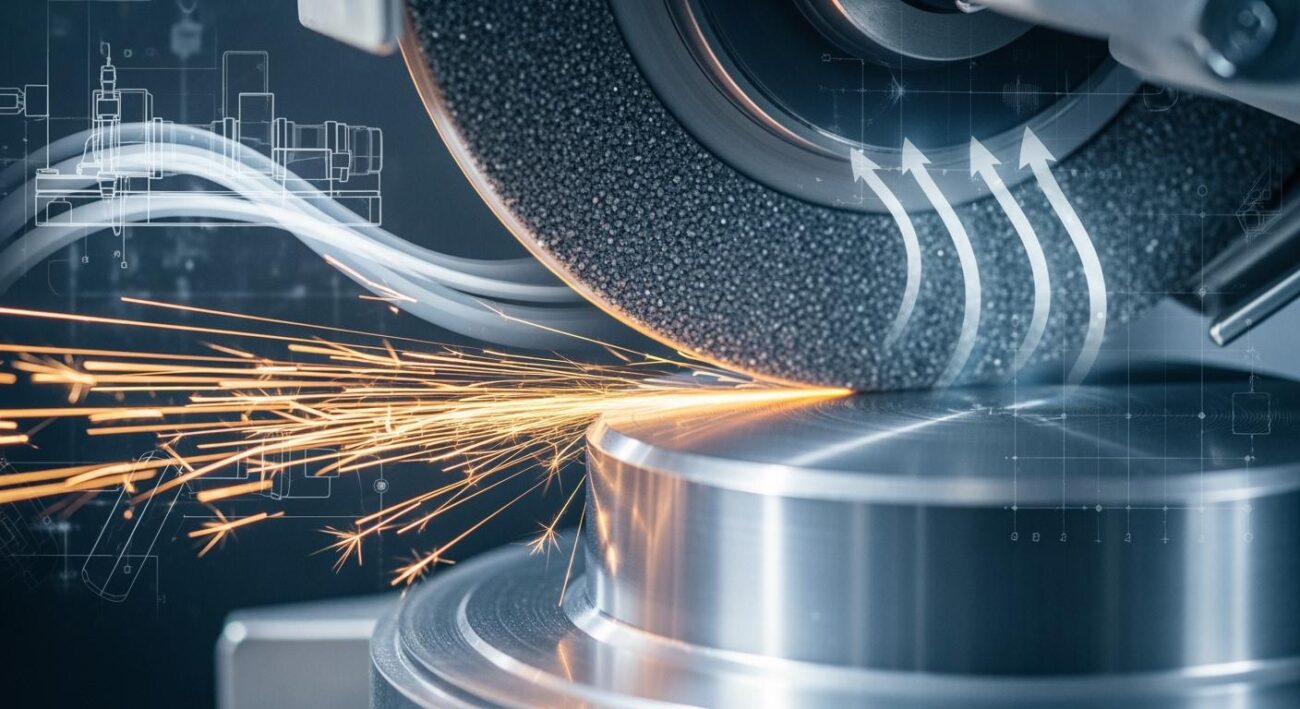
Beyond concentration, check the nozzle position and the flow: aim the nozzle at the grinding zone, and at high wheel speeds watch the air barrier. Use enough flow to wash the chips away before they get re-rolled under the wheel and ground a second time.
Expert Tip: “Richer is better” is the most expensive coolant myth in the shop. Concentration that is too high makes the wheel slide instead of cut — you pay more for fluid and get less material removed. Measure with a refractometer, do not guess by eye.
Check 6: Two Blind Spots — Underspeed and the New-Wheel Break-In
Blind Spot One: Wheel Speed Too Low
Faster is not always better, but too slow is a real fault. Overspeed sheds grains and scratches the work. Underspeed is the opposite failure — and it is not an absolute number; it is relative to the range a wheel is built to run in.
A CBN wheel meant for 80–120 m/s that crawls at 30–40 loads every grain too heavily and never breaks out fresh edges — the whole wheel is dozing off. Typical causes: the wheel has worn down in diameter and the spindle speed was never raised, or the machine simply has no higher spindle range — old grinders step into this trap all the time.
Plain alumina at 25–35 m/s is perfectly normal, so do not judge it by CBN standards. Before you call a wheel underspeeded, find out how fast this particular wheel is supposed to run.
Blind Spot Two: The New Wheel Was Never Broken In
Can a new wheel cut straight out of the box? No. A new wheel used without dressing cuts at only about 40% of its efficiency. The grains sit in disorder, carry micro-cracks, and may not have broken through to the surface at all.
Every new wheel needs the full five-step break-in:
| Step | Action | Note |
|---|---|---|
| 1 | Static balance | Wheel holds any angle without turning |
| 2 | No-load run | 50% of operating speed for 5 minutes; listen for noise and vibration |
| 3 | Rough truing | Diamond dresser at about 15°, until a continuous stream of sparks appears |
| 4 | Fine truing | 3–5 spark-out passes with no infeed |
| 5 | Conditioning with a dressing stick | Mandatory for ceramic- and metal-bond superabrasive wheels, 30–60 seconds |
And one storage trap: resinoid wheels that get damp delaminate like a biscuit — keep humidity at 40–60%. Alumina grains absorb oil and dull. Vitrified wheels fear drops and oil contamination. Store a wheel badly and half of it is dead before it ever reaches the spindle.
Expert Tip: Underspeed is the most overlooked cause of “won’t cut” on old machines. If the wheel has worn down and the spindle speed was never adjusted, or the machine simply cannot run fast enough for a superabrasive wheel, no amount of parameter tuning will fix it.
The Bright-Surface Trap
One thing is easy to misread while you work through these checks. The surface suddenly turns brighter — do not celebrate yet.
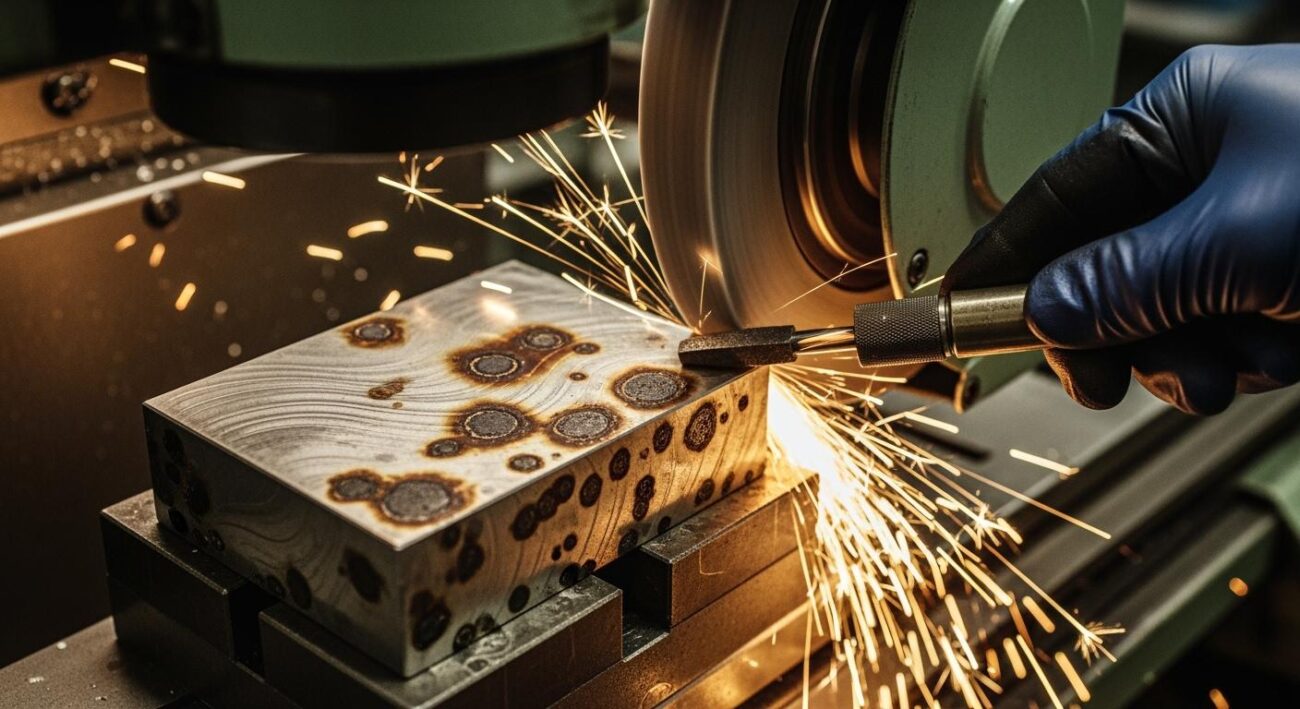
Brightness up while the sparks shrink means the grains are squeezing the surface, not cutting it; the wheel is glazing. The dull grains are pushed across the workpiece by the bond, leaving a pressed surface rather than a cut surface. Roughness may look low, the part may look shiny, but the surface layer has plastic deformation and residual stress.
Three signals appear together when a wheel is glazing: the sparks shrink, the sound turns dull, and the workpiece turns bright and hot. If “brighter is better” is your yardstick, all the checks above can go to waste.
Expert Tip: A surface that suddenly looks better is often a warning, not a win. Bright plus fewer sparks is glazing. Bright with full sparks and a clean sound can be legitimate. Read the three signals together — sparks, sound, and surface — before deciding.
The Classic Case: Stainless and Titanium
Gummy materials — austenitic stainless like SUS304/316 and titanium — are where “won’t cut” shows up most often and most clearly.
Why They Are Difficult
Austenitic stainless accounts for 60–70% of stainless production. It has high toughness, high elongation, low thermal conductivity (about one-third of carbon steel), and low elastic modulus. Local grinding zone temperatures can reach 700–1000°C, and stainless begins to soften at 700°C. Adhesion is strong, so chips stick to the wheel easily.
Typical Mismatches
| Variable | Wrong Choice | Correct Direction |
|---|---|---|
| Abrasive | White alumina (WA) — sticks and loads | Single-crystal alumina (SA), microcrystalline, or CBN |
| Hardness | K grade — too hard, dull grains cannot release | J grade, softer side |
| Structure | Tight — small chip space, loads fast | 7–9 open structure |
| Coolant | 3% concentration — insufficient lubrication | 6–8% concentration, higher flow |
| Dressing frequency | Only when it stops cutting — too late | Watch the signals; heavy-stock parts may need dressing every few pieces |
The lesson: for gummy materials, roughly 80% of “won’t cut” comes from selection mismatch and 20% from the process not keeping up. Simply buying a more expensive wheel will not help — the five selection variables, the dressing method, and the coolant concentration have to be adjusted together.
Expert Tip: On gummy materials, the “process not keeping up” shows as insufficient dressing frequency and insufficient coolant concentration — not filtration. Filtration is the scratches problem. Concentration is the “won’t cut” problem.
The Order to Run the Checks
Work from the cheapest fixes to the most expensive. Do not start by buying a new wheel.
| Step | Action | Cost |
|---|---|---|
| 1 | Sort the symptom: glazing, loading, or end of life | Free |
| 2 | Check dressing method and frequency; condition the wheel | Free |
| 3 | Check coolant concentration and nozzle position | Free |
| 4 | Verify wheel speed against the recommended range | Free |
| 5 | Confirm the new-wheel break-in routine was followed | Free |
| 6 | Review selection: hardness, abrasive, grit, structure, bond | Paid |
The order: sort the symptom first, then work selection before system. Start with free items — dressing method and frequency, coolant concentration, the break-in routine — none of them cost a cent. Only after those should you spend money on a different abrasive, hardness, or grit.
Expert Tip: “Won’t cut” is not like scratches. In the scratches case, nine out of ten causes lived in the machine and the process. Here, half of them live in the selection. Different distribution, different order of attack.
Frequently Asked Questions
Why does my wheel stop cutting no matter how many I change?
✅ Because changing wheels is not the same as changing specifications. If you are only switching brands or suppliers, the abrasive, hardness, grit, structure, and bond have not changed — and the root cause has not been addressed. A wheel that will not cut is usually a selection problem, not a quality problem.
How can I tell glazing from loading?
✅ Look at the wheel face. Glazing leaves it clean but shiny — the grit tips are flattened and no swarf is attached. Loading leaves it dark with swarf packed into the pores. Both produce shrinking sparks and a dull sound; the face color is the quick way to separate them. Glazing needs dressing and a softer grade; loading needs more porosity and better coolant.
Is harder workpiece really supposed to run a softer wheel?
✅ Yes. The harder the workpiece, the faster the grains dull. A harder wheel holds those dull grains in place, so the wheel fills with blunt edges and cuts worse and worse. A softer bond lets dull grains drop out in time and exposes fresh edges underneath. Hardened steel typically runs J–K grades, on the softer side.
Why does a wheel cut poorly right after dressing?
✅ You probably trued it but did not condition it. Truing makes the wheel round and in profile, but it leaves a film of bond covering the grains. For vitrified CBN especially, a 30–60 second pass with a green silicon-carbide dressing stick is mandatory to open the face and expose sharp edges. Metal-bond CBN requires electrolytic conditioning. Feel the face — prickly means conditioned, smooth means not.
Why does a new wheel cut poorly out of the box?
✅ A new wheel used without dressing cuts at only about 40% of its efficiency. The grains are disordered, carry micro-cracks from transport, and may not have broken through to the surface. Every new wheel needs the full five-step break-in: static balance, no-load run, rough truing, fine truing, and conditioning. Skipping steps leaves a wheel that behaves like a dull knife from the first part.
Key Takeaways
- A wheel that will not cut is usually a selection problem, not a quality problem.
- Sort the symptom first: glazing (clean, shiny), loading (dark, packed), or end of life (sudden failure).
- Harder workpiece needs a softer wheel. This feels backwards, and it is correct.
- Diamond cannot grind steel. Iron-based materials need CBN. The hardest abrasive is not the most universal.
- Grit follows stock removal. Do not expect a fine-grit wheel to evacuate roughing-size chips.
- Gummy materials need open structure (7–9) and a softer grade.
- Dressing is two jobs: truing and conditioning. Truing without conditioning leaves a dull knife.
- Coolant concentration matters: 3% is too thin, above 10% is too rich. Both cause “won’t cut” for opposite reasons.
- Underspeed is relative to what the wheel is designed to run. A CBN wheel at 30–40 m/s is dozing off.
- New wheels need break-in. Straight out of the box, they cut at roughly 40% efficiency.
- Brightness up with sparks down is glazing, not improvement.
- Run the checks cheapest first. Free items come before paid items.
More grinding questions? Need a custom wheel solution?
Contact Us →