

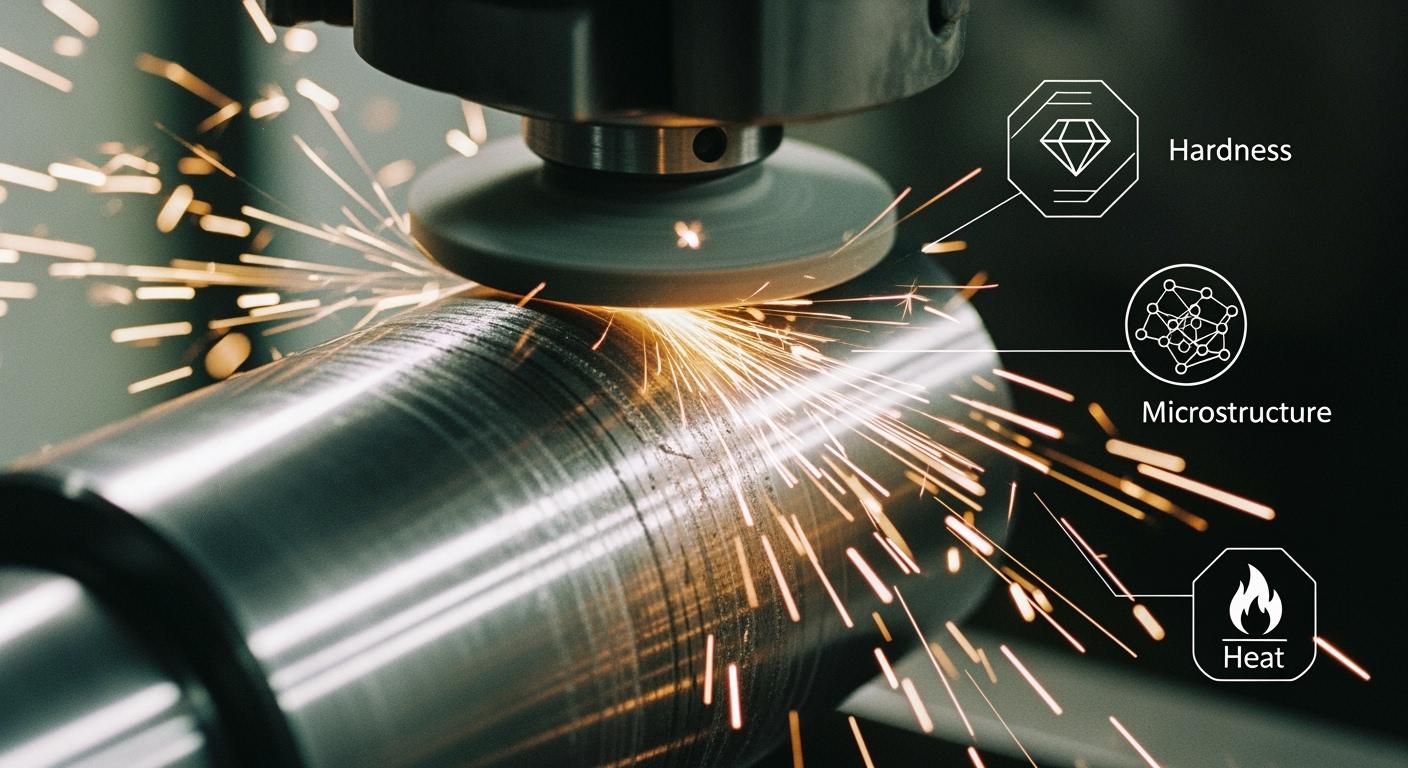
You face special material challenges when grinding bearing steel. Hardness and microstructural sensitivity demand precise control. Cleanliness affects surface quality and bearing performance. Grinding problems like burn, chatter, and wheel wear can harm performance by causing microcracks, uneven finishes, and downtime. These issues reduce surface quality and lower bearing performance.
Grinding Issue Impact on Performance and Surface Quality Grinding Burn Causes discoloration, microcracks, and hardness loss Unstable Finish Leads to inconsistent roughness affecting sealing and fit Wheel Wear Raises costs and reduces manufacturing efficiency Grinding Chatter Creates vibration marks, hurting dimensional accuracy
Understanding these special material challenges helps you improve bearing performance and surface quality effectively.
Key Takeaways
- Grinding bearing steel requires careful control of hardness and microstructure to avoid damage and maintain performance.
- Cleanliness is crucial; reducing non-metallic inclusions improves fatigue life and prevents early failure in bearings.
- Achieving a smooth surface finish is essential for proper bearing function; monitor grinding parameters to avoid defects.
- Using Aimgrind CBN grinding wheels enhances efficiency, reduces thermal damage, and improves surface quality.
- Regular quality checks and monitoring of grinding parameters ensure consistent performance and longevity of bearing components.
Special Material Challenges in Bearing Steel Grinding
Hardness and Microstructure Effects
When you grind bearing steel, hardness plays a crucial role. Bearing steel often reaches very high hardness levels after heat treatment. This hardness makes grinding difficult because the material resists cutting forces. You must control grinding parameters carefully to avoid damage.
Grinding affects the microstructure of bearing steel. For example, grinding with Cubic Boron Nitride (CBN) wheels can induce beneficial compressive residual stresses ranging from -200 to -800 MPa. These stresses improve fatigue life by making the surface more resistant to crack formation. However, if grinding generates too much heat, it can cause tensile stresses, which weaken the steel and increase the risk of cracks.
Microhardness near the surface usually stays the same or increases slightly during proper grinding. Excessive heat, however, can reduce hardness and create a brittle white layer. This white layer forms when the steel overheats and changes its microstructure. It can cause early failure in rolling bearings because it is prone to cracking.
| Aspect | CBN Hard Turning | CBN Grinding |
|---|---|---|
| Residual Stresses | Induces beneficial compressive stresses | Can produce compressive or harmful tensile stresses |
| Microhardness Changes | Can increase surface hardness | Usually maintains or slightly increases hardness |
| White Layer Formation | Less prone to thick white layers | High risk if cooling is insufficient |
You must balance grinding speed, feed, and coolant flow to protect the microstructure. Proper control helps maintain hardness and avoid defects that reduce bearing steel performance.
Cleanliness and Inclusion Issues
Cleanliness in bearing steel means having very few non-metallic inclusions like oxides and sulphides. These inclusions act as weak points in the steel. When you grind bearing steel, inclusions can cause pits or voids because the softer steel matrix around them wears away faster. These pits become starting points for micro-cracks, which reduce the fatigue life of rolling bearings.
Steel manufacturers use standards like ASTM E 45 and DIN 60502 to measure inclusion content. These tests help ensure the steel meets cleanliness requirements. Modern bearing steel often has very low inclusion levels, improving reliability.
- The Jernkontoret inclusion-rating scale shows historical inclusion levels but modern clean steels often score so well that the scale loses meaning.
- Statistical methods, such as Weibull analysis, help compare cleanliness levels between steel heats.
- High cleanliness reduces oxygen and non-metallic inclusions, which improves rolling contact fatigue resistance.
Note: The RKB Group worked closely with its steel supplier to reduce oxygen and inclusion content. This collaboration improved the cleanliness of bearing steel and enhanced bearing performance.
Maintaining cleanliness during grinding is also important. You should avoid grinding conditions that expose or enlarge inclusions. Otherwise, surface quality suffers, and bearing life shortens.
Surface Quality Concerns
Surface quality directly affects bearing performance. You must achieve a smooth, defect-free surface to ensure proper bearing function. Surface roughness influences bearing torque and fatigue life. Poor surface finish can cause uneven load distribution and early failure.
You can measure surface quality using instruments like the PGI contact aspheric surface measuring device. It evaluates surface roughness (Ra) and surface integrity by analyzing texture and physical characteristics.
| Surface Quality Concern | Measurement Method |
|---|---|
| Surface Integrity | Evaluated through surface texture and physical characteristics |
| Surface Roughness (Ra) | Measured using a PGI contact aspheric surface instrument |
Common grinding defects include burns, chatter marks, scratches, and wheel glazing. These defects reduce surface quality and cause bearing steel inaccuracies.
| Defect Type | Description |
|---|---|
| Workpiece Is Burnt or Cracked | Thermal damage from excessive heat during grinding, leading to inaccuracies and potential failure |
| Grinder Is Making Noise (Chatter) | Vibration causing wave marks on the workpiece, indicating setup or operational problems |
| Workpiece Inaccuracy | Incorrect setup or wheel dressing causing precision issues |
| Scratches or Spirals on Workpiece | Surface imperfections caused by improper wheel operation or unsuitable wheel types |
| Wheel Glazing | A smooth, shiny wheel that is too blunt for effective grinding, often due to incorrect specs |
You should monitor grinding parameters closely to avoid these issues. Using advanced grinding wheels like CBN wheels helps maintain cooler operation and reduces thermal damage. This leads to better surface finish and longer bearing life.
The surface finish, combined with material cleanliness and proper raceway profiles, plays a key role in bearing longevity. Inclusions cause stress concentrations that lead to subsurface spalling. Poor raceway profiles cause edge loading and micro-pitting. You must control all these factors to optimize bearing steel grinding results.
Impact of Impurities on Bearing Performance
Types of Inclusions in Bearing Steel
You often find different types of inclusions in bearing steel. These include oxides, sulphides, and silicates. Each type can affect grinding in a unique way. Oxide inclusions come from oxygen in the steel. Sulphide inclusions form when sulfur reacts with other elements. Silicate inclusions result from silicon. When you grind bearing steel, these inclusions can become weak spots. They do not bond well with the steel matrix. During grinding, inclusions may break loose or cause pits. This weakens the surface finish and makes the steel more likely to crack under stress.
Effects on Grinding and Surface Finish
Grinding bearing steel with inclusions creates many challenges. You may notice that inclusions cause uneven wear on the grinding wheel. This leads to a rougher surface finish. When inclusions are present, the grinding process can pull them out of the steel. This leaves small holes or voids on the surface. These defects lower the quality of the surface finish. You might also see more grinding wheel wear because inclusions are harder or softer than the steel around them. This difference in hardness causes the grinding wheel to cut unevenly. You need to monitor grinding parameters closely to reduce these effects. Using advanced grinding wheels helps you achieve a better surface finish and reduces wear.
Tip: Always check the grinding wheel for signs of uneven wear. This helps you spot problems caused by inclusions early.
Fatigue and Longevity Risks
Impurities in bearing steel have a big impact on fatigue and bearing service life. When you grind steel with inclusions, you create stress points. These points make it easier for cracks to start. Over time, cracks grow and lead to failure. Studies show that non-metallic inclusions in the subsurface region of bearings are critical in starting cracks. High stress around these inclusions shortens fatigue life. Modern clean steel has fewer critical-sized inclusions. This means you get longer fatigue life and better bearing service life. If you want to improve bearing performance, you must control inclusions and use proper grinding techniques. Good surface finish and low wear rates help you avoid early fatigue and extend bearing service life.
| Factor | Effect on Fatigue Life and Bearing Service Life |
|---|---|
| Inclusion Content | More inclusions mean shorter fatigue life |
| Surface Finish | Poor finish increases risk of crack formation |
| Grinding Wear | High wear leads to more defects |
Solutions for Grinding Bearing Steel with Aimgrind CBN Wheels
CBN Wheel Advantages for Hard Materials
You need the right tool for grinding hard bearing steel. Aimgrind CBN grinding wheels give you many advantages over conventional wheels. These wheels handle high temperatures without losing hardness. You can use them for hardened steel, bearing steel, HSS, and nickel-based alloys. The wheels remove material quickly and keep precision high. You will notice that the wheel lasts much longer than standard or diamond wheels. You can use Aimgrind CBN grinding wheels for both wet and dry grinding. This flexibility helps you match the grinding process to your needs.
- Superior heat resistance keeps the wheel strong during grinding.
- High material removal rate means you finish jobs faster.
- Longer wheel life saves you time and money.
- Consistent precision improves your surface finish.
- Suitable for wet and dry grinding processes.
Optimizing Surface Finish and Precision
You want a smooth surface finish on every bearing. Aimgrind CBN grinding wheels help you achieve this goal. The wheels keep their shape and sharpness, so you get a consistent finish every time. You can control the grinding process better with these wheels. This control lets you avoid burns, chatter, and other defects. You should always check the wheel for wear and adjust your grinding parameters as needed. Using the right coolant flow also helps keep the surface cool and prevents thermal damage. Aimgrind CBN grinding wheels support high productivity and optimization strategies for your shop.
| Feature | Benefit for Surface Finish |
|---|---|
| Wheel Shape Retention | Consistent finish and accuracy |
| Cooler Operation | Less risk of burns or cracks |
| High Precision | Smooth, defect-free surfaces |
Heat Treatment and Process Control
Heat treatment changes how bearing steel responds to grinding. You must select the right heat treatment to get the best results. Proper heat treatment increases hardness and reduces distortion. This helps your components fit together after grinding. Quenching makes the steel harder, but it can also make grinding more difficult. Annealing softens the steel, making grinding easier but sometimes causing smearing. You should use heat treatment methods like spheroidizing annealing and quenching to get the best performance from your bearing steel.
Process control is also important. You need to control vibration to avoid chatter. Use condition monitoring systems to catch faults early. Regularly check for chatter vibrations to keep your product quality high. These steps help you reduce defects and improve your grinding results.
Tip: Always monitor your grinding process and adjust parameters for the best finish and longest wheel life.
Quality Control in Bearing Steel Grinding
Inspection for Material Consistency
You need to check material consistency before and after grinding. This step helps you catch problems early and keep your bearing parts strong. Use several methods to make sure your grinding process meets high quality standards.
| Method | Description |
|---|---|
| Process Control | Ensures repeatability and compliance through robust quality control practices. |
| Dimensional Inspections | Integral for early detection of deviations, allowing corrective actions before issues propagate. |
| Surface Roughness Measurements | Helps maintain quality standards by monitoring surface finish. |
| Geometric Verification | Ensures that parts meet specified geometric tolerances, crucial for performance in tight applications. |
You can also use magnetic Barkhausen noise measurement.
Magnetic Barkhausen noise (BN) measurement is a non-destructive method for the fast and data-based inspection of machined surfaces regarding grinding burn. While post-process Barkhausen noise inspection is already used in industry, the application directly during machining is a current research field.
This method helps you protect the integrity of your bearing steel and maintain accuracy.
Monitoring Grinding Parameters
You must monitor grinding parameters to keep your process stable and accurate. Real-time monitoring systems use sensors and thermal imaging to detect grinding burns. These systems help you make quick adjustments and prevent surface damage. Acoustic emission is another modern technique. It gives you more control over the grinding process and helps you achieve better geometric accuracy.
| Method | Description |
|---|---|
| In-process measurement | Enables real-time measurement and adjustment of the grinding process, enhancing precision and accuracy. |
| Probing and Sensing | Utilizes advanced probes for in-situ measurement, minimizing dimensional errors during grinding. |
| Force Monitoring Systems | Monitors grinding forces to detect anomalies, improving cycle times and preventing equipment damage. |
You should always check grinding forces and temperatures. This practice helps you maintain the integrity and accuracy of your bearing parts.
Ensuring Surface Quality
You want every bearing to have a smooth, defect-free surface. Select the right CBN wheel specifications, such as grit size and bond type, for your grinding task. Adjust grinding parameters like wheel speed and infeed rates to achieve the best surface quality enhancement. Use proper wheel truing and dressing to keep your grinding wheel sharp and effective. Coolant management is also important. It prevents thermal damage and keeps the surface cool.
| Method | Description |
|---|---|
| CBN Wheel Specifications | Selecting the right grit size, concentration, and bond type is crucial for effective grinding. |
| Grinding Parameters | Adjusting wheel speed, work speed, infeed rates, and spark-out time is essential for achieving consistent surface quality. |
| Wheel Truing and Dressing | Implementing effective techniques for wheel truing and dressing helps maintain performance and surface finish. |
| Coolant Management | Proper coolant application prevents thermal damage and enhances surface quality during grinding. |
Common defects include cracks, pitting, and scratches. Use automatic magnaflux inspection and billet grinding to remove these defects. Always check for surface cracks using magnetic imaging or ultrasonic testing. Quick action helps you keep the integrity and accuracy of your bearing steel high.
You face unique material challenges in grinding bearing steel. These challenges affect both performance and surface quality. Advanced solutions like Aimgrind CBN grinding wheels and strong quality control help you achieve better results. The table below shows how these tools improve your process:
| Benefit | Contribution to Bearing Performance and Surface Quality |
|---|---|
| Hardness | Ensures precise material removal and tight tolerances |
| Thermal Stability | Maintains performance under high temperatures |
| Sharp Cutting Edges | Achieves exceptional surface finishes with minimal defects |
You should always focus on material quality and use innovative grinding tools. This approach reduces friction, saves energy, and supports efficient manufacturing. As industries grow, especially in mining and electric vehicles, you need to address these grinding challenges for future success.
FAQ
What makes bearing steel difficult to grind?
You face high hardness and microstructural sensitivity in bearing steel. These properties make grinding tough. You must use precise tools and control heat to avoid surface damage.
How do inclusions affect bearing steel grinding?
Inclusions act as weak spots. When you grind, these can cause pits or cracks. You need clean steel and careful grinding to prevent early failure.
Why should you choose Aimgrind CBN grinding wheels?
Aimgrind CBN wheels offer high hardness and thermal stability. You get faster cutting, cooler operation, and longer wheel life. These features help you achieve better surface quality and reduce downtime.
How can you improve surface quality during grinding?
Select the right CBN wheel and adjust grinding parameters. Use proper coolant flow. Regularly check for defects. These steps help you get a smooth, defect-free surface.
What quality checks should you perform after grinding?
Always inspect for cracks, burns, and surface roughness.
Use tools like magnetic imaging or ultrasonic testing.
These checks help you ensure strong and reliable bearing parts.
Contact Us
For More Grinding Solution or Customized Abrasive Tools