

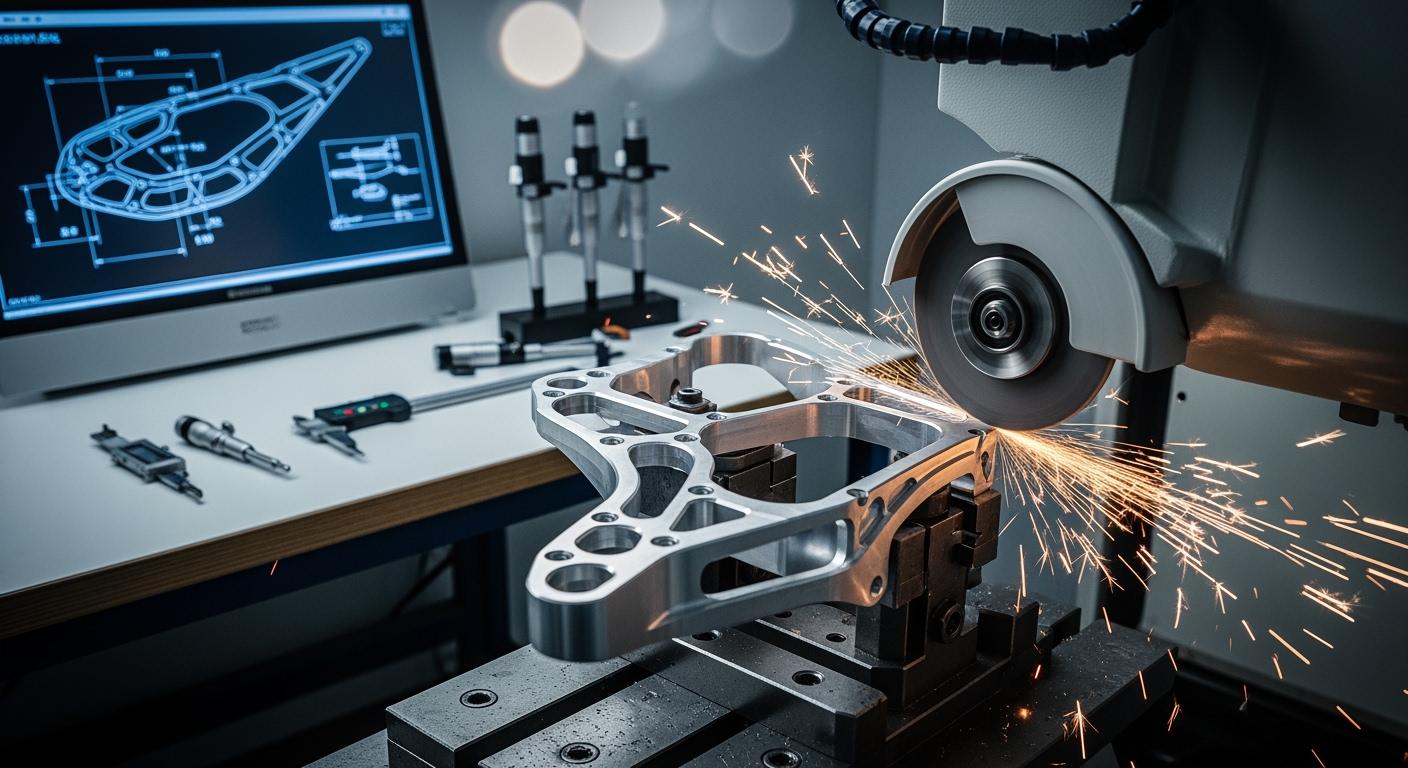
You can achieve distortion-control grinding by focusing on the right solutions for thin-walled and complex non-ferrous components. Precision and accuracy matter most when you work with thin-walled components because even small errors can lead to distortion. If you use advanced solutions like Aimgrind diamond grinding wheels, you improve distortion-control grinding and boost precision. Several factors can cause distortion in thin-walled components, such as:
- Poor clamping that allows the components to move
- Residual stress in the components’ raw material
- Thin-walled or complex shapes in the components
- Incorrect tool paths or grinding forces
- Improper cooling during grinding solutions
You need solutions that support distortion-control grinding and help you maintain accuracy. Precision solutions, such as customized grinding wheels, workholding solutions, and cooling solutions, help you achieve the best results for thin-walled components. When you choose the right solutions, you gain better control, more precision, and higher accuracy for all your components.
Key Takeaways
- Use Aimgrind diamond grinding wheels for precision in thin-walled components. These wheels enhance accuracy and reduce distortion.
- Select the right grinding tools and parameters to avoid damaging thin-walled parts. Match wheel hardness, grit size, and bond type to your material.
- Implement effective cooling strategies during grinding. Proper coolant application prevents thermal distortion and maintains surface integrity.
- Ensure secure workholding techniques to stabilize thin-walled parts. Use vacuum chucks or custom soft jaws to avoid deformation during machining.
- Monitor for vibration and temperature throughout the grinding process. This helps maintain precision and prevents unwanted changes in your components.
Distortion-Control Grinding Tool Selection
Choosing the right grinding tools and parameters is essential for distortion control in thin-walled parts. You need to focus on precision when you work with thin-walled components. If you select the wrong grinding wheel or abrasive, you risk damaging the parts and losing accuracy. Thin-walled parts require careful machining because they can bend or deform easily. You must use grinding wheels that match the material and shape of your components. Precision machining helps you avoid distortion and achieve the best results for thin-walled parts.
Aimgrind Diamond Grinding Wheels for Thin-Walled Parts
You can rely on Aimgrind diamond grinding wheels for thin-walled parts. Aimgrind offers customized grinding wheels designed for precision machining of thin-walled components. These wheels use advanced diamond abrasives that deliver high cutting efficiency and long service life. You get consistent performance and tight tolerances, which are important for precision components in manufacturing. Aimgrind diamond grinding wheels maintain their shape and sharpness, so you can achieve accurate results in cnc machining and kovar machining.
Aimgrind provides wheels with different bond types, such as resin, metal, and vitrified. Vitrified bonds hold their form well, which is crucial for thin-walled parts. You get reduced vibration and improved surface finish. Dimensional accuracy matters in applications like automotive and bearing manufacturing. Aimgrind’s expertise in custom wheel design helps you match the grinding wheel to your cnc machining process and kovar machining needs. You can use these wheels for precision machining of kovar, ceramics, and composites.
Tip: When you use Aimgrind diamond grinding wheels, you improve distortion control and boost precision in thin-walled parts. You also reduce downtime and increase productivity in manufacturing applications.
Matching Abrasive Types and Parameters
You must match abrasive types and parameters to your thin-walled parts. If you choose the wrong abrasive, you risk overheating or damaging the components. You need to consider wheel hardness, grit size, wheel structure, and bond type for precision machining. Here are the most critical parameters for minimizing distortion in thin-walled non-ferrous component grinding:
- Wheel Hardness: Medium to soft bonds help avoid retaining dull grains, which can cause heat and distortion.
- Grit Size: Medium to coarse grit (36–60) prevents clogging and allows effective material removal without damaging thin-walled parts.
- Wheel Structure: Open-structure wheels enhance chip clearance and reduce heat buildup in kovar machining and cnc machining.
- Bond Type: Rubber and shellac bonds produce smoother cuts with less heat transfer, making them suitable for precision applications.
You can see how abrasive selection impacts distortion control in grinding processes. The table below shows findings from recent studies:
| Study | Findings |
|---|---|
| Yadav et al. [13] | Used a material model to analyze abrasive interaction and predicted compressive residual stress and localized plastic deformation in thin-walled parts. |
| Li et al. [14] | Developed a grinding model for GaN crystals, showing ductile removal increased with higher wheel speed and smaller abrasive size. |
| Li et al. [20] | Simulated double-grit interaction grinding, revealing optimized grit interaction improved grinding efficiency and damage control in precision machining. |
You must select the right grinding wheel bond type for thin-walled parts. Rigid bonds like vitrified maintain their shape, which is important for precise grinding of thin-walled components. You get tight tolerances and reduced vibration, which improves surface finish and reduces wear on machinery. These features help you achieve precision in kovar machining and cnc machining applications.
If you match the abrasive type and parameters to your thin-walled parts, you improve distortion control and achieve precision machining. You can use Aimgrind diamond grinding wheels for kovar machining, ceramics, and composites. You get reliable results in manufacturing applications and precision components.
Minimizing Stress in Thin-Walled Grinding
Reducing Mechanical and Thermal Loads
You face many challenges when you grind thin-walled components. These parts bend and distort easily. You must control both mechanical and thermal loads during machining. If you use the wrong grinding parameters, you increase the risk of distortion and poor surface finish. The table below shows how different grinding parameters affect mechanical loads and distortion in thin-walled machining:
| Grinding Parameter | Effect on Mechanical Loads and Distortion |
|---|---|
| Lower speeds and feed rates | Reduces heat buildup and minimizes surface defects like chatter or burn marks. |
| Shallow depth of cut (0.001–0.005 inches) | Reduces stress on the workpiece, preventing micro-cracking. |
| Optimal coolant application | Prevents thermal distortion and maintains consistent surface integrity. |
| Rigid cast iron bases | Resists deformation under load, ensuring consistent contact with the workpiece. |
| Spindle accuracy (runout < 0.0001″) | Critical for achieving sub-micron surface finishes, affecting distortion. |
| Proper fixturing | Prevents vibration and distortion, especially in thin-walled components. |
You can reduce thermal loads by using cooling strategies. Mist cooling, directed air jets, and liquid coolant systems help keep temperatures stable during machining. These methods prevent thermal expansion and contraction, which can cause thin-walled components to warp. Active thermal control systems also help regulate temperature and minimize distortion. You should always check your setup for sources of vibration. Even small amounts of vibration can lead to poor surface finish and loss of precision in thin-walled machining.
Tip: Always monitor for vibration during machining. Even a small amount can cause distortion in thin-walled components.
Managing Residual Stress for Precision
Residual stress can build up in thin-walled components during machining. This stress affects the final shape and precision of your parts. You need to understand the types of residual stress that can form:
- Type I Stresses: Long-range stresses from macrostrains.
- Type II Stresses: Self-equilibrating stresses at the grain size level.
- Type III Stresses: Stresses at the atomic scale from dislocations or lattice changes.
You can measure residual stress using destructive methods like the blind-hole or contour method. Non-destructive methods, such as X-ray diffraction and neutron diffraction, let you check stress without damaging your thin-walled components. Many engineers use the Finite Element Method (FEM) to predict residual stress during machining. FEM models help you see how grinding and temperature changes affect thin-walled parts. Thermo-mechanical coupling models also improve your ability to predict stress and temperature distribution.
Residual stress links directly to dimensional accuracy in thin-walled machining. Studies show that surface residual stress is often tensile and becomes compressive deeper in the part. This change can cause shape distortion, especially if you use a deep cut or if the material has a high nodule count. The grinding wheel type and coolant use also affect surface finish and precision. Lower residual stress and a better finish mean your thin-walled components will last longer and resist fatigue.
Note: Always use optimal grinding conditions to lower residual stress. This improves both the precision and durability of your thin-walled components.
Workholding and Fixturing for Thin-Walled Parts
Secure Fixturing Techniques
You need strong workholding to keep thin-walled parts stable during machining. The importance of workholding becomes clear when you see how easily thin-walled parts can bend or deform. Good workholding keeps your parts in place and helps you get high quality and dimensional accuracy. You can use advanced techniques for thin-walled workholding to improve quality and reduce errors.
Many shops use vacuum chucks for thin-walled parts. Vacuum chucks hold parts without heavy clamping, so you avoid crushing or distorting the material. Custom soft jaws fit the shape of your part and give better support. Low-force clamping systems help you avoid too much pressure. Adhesive workholding works well for ultra-thin parts that cannot handle any clamping force. These methods all help you keep stability and quality during machining.
- Vacuum chucks secure thin-walled parts with gentle force.
- Custom soft jaws match the part’s shape for better support.
- Low-force clamping systems lower the risk of deformation.
- Adhesive workholding holds ultra-thin parts safely.
You can also use damping materials like rubber or foam. These materials absorb vibrations and add stability. Optimized cutting parameters reduce chatter and improve surface quality. A precision axial clamping method with countersunk screws and shallow cuts can help you keep tight tolerances and maintain the shape of thin-walled aluminum parts.
Adaptive Supports to Prevent Deformation
Adaptive supports play a big role in workholding for thin-walled parts. You need these supports to keep your parts from moving or flexing during machining. Stability is key for quality and dimensional accuracy. You can use temporary ribs or wax bed supports to add strength during grinding. After machining, you remove these supports, leaving your thin-walled parts in perfect shape.
The table below shows how different workholding methods compare for thin-walled parts:
| Workholding Method | Best For | Support Level | Setup Time | Material Cost |
|---|---|---|---|---|
| Low-Melt Alloy | One-offs, prototypes | Excellent (100%) | 30-45 minutes | $$$ |
| Vacuum Chuck | Large flat plates | Very Good (90%) | 2-5 minutes | $$$$ |
| Wax Bed Support | Budget projects | Good (75%) | 15-20 minutes | $ |
| Temporary Ribs | Production runs | Good (70%) | None (in CAM) | Free |
You should always check your workholding setup before you start machining. Good cnc workholding helps you keep stability and quality. You need to use quality control measures to check for movement or vibration. If you see any problems, adjust your clamping or supports. This helps you keep dimensional accuracy and high quality in every part.
Tip: Always use advanced techniques for thin-walled workholding and quality control measures to get the best results. The importance of workholding cannot be overstated for thin-walled parts.
Cooling and Process Optimization
Advanced Coolant Delivery for Precision
You need to manage temperature during grinding to control distortion in thin-walled parts. Cooling systems play a big role in this process. If you use advanced coolant delivery, you keep the workpiece stable and prevent unwanted changes in shape. Water-based coolants remove heat quickly. Oil-based systems provide strong lubrication for certain materials. Minimum quantity lubrication gives you environmental benefits and keeps thermal damage low. The table below shows how different cooling methods help you in the process:
| Cooling Method | Benefits |
|---|---|
| Water-based coolants | Excellent heat removal capabilities, preventing thermal damage. |
| Oil-based systems | Superior lubrication properties for specific material combinations. |
| Minimum quantity lubrication | Combines environmental benefits with effective thermal management, enhancing overall performance. |
You can also use cold mist or cryogenic cooling to lower the temperature even more. These methods reduce deflection and keep thin-walled parts in shape. The table below shows how coolant type and temperature affect distortion control:
| Coolant Type | Temperature | Deflection Reduction (%) | Comparison to Flood Cooling | Comparison to MQL |
|---|---|---|---|---|
| CMQL | -15 °C | 56.97 | Yes | Yes |
| CMQL | -15 °C | 32.51 | Yes | Yes |
Tip: Always check coolant flow and temperature during cnc machining. You improve distortion control and keep your process stable.
Process Sequencing and Simulation
You must plan your process steps to control distortion. Process sequencing helps you decide the order of machining tasks. If you start with rough grinding and finish with fine grinding, you reduce stress and keep the part shape. Simulation tools let you predict how the process will affect thin-walled parts. You can use real-time monitoring to check for problems during cnc machining. Acoustic emission sensors help you spot wheel wear or material changes. You can take action right away to keep precision high. Here are some ways real-time monitoring helps you in the process:
- In-process systems, like acoustic emission sensors, identify wheel wear or material anomalies.
- Immediate corrective actions keep precision high in grinding.
- Monitoring prevents distortion during grinding of thin-walled non-ferrous components.
You get better results when you combine process sequencing, simulation, and real-time monitoring. You control distortion and improve optimization in every machining step. You keep your thin-walled parts accurate and strong.
You can control distortion in thin-walled and complex non-ferrous components by using optimized process parameters, advanced binder materials, and custom support structures. Aimgrind diamond grinding wheels help you achieve precision and reduce tool wear. You should monitor temperature and cooling rates to prevent warping. The table below shows key strategies from recent research:
| Strategy | Description |
|---|---|
| Optimizing process parameters | Adjusting speed, thickness, and drying conditions to minimize distortion. |
| Employing support structures | Using custom supports to maintain critical dimensions. |
| Computational modeling | Using predictive tools to compensate for distortion. |
Keep evaluating and adapting your grinding process for the best results.
FAQ
What makes Aimgrind diamond grinding wheels ideal for thin-walled parts?
You get high precision and durability with Aimgrind diamond grinding wheels. These wheels maintain their shape and sharpness. You achieve tight tolerances and reduce distortion in thin-walled and complex non-ferrous components.
How do you prevent distortion during grinding?
You control distortion by using secure workholding, advanced cooling, and optimized grinding parameters. You monitor vibration and temperature. You select the right abrasive and bond type for your material.
Can you use Aimgrind wheels for both wet and dry grinding?
Yes, you can use Aimgrind diamond grinding wheels for wet and dry grinding. These wheels work well with different materials. You choose the best method based on your application and desired surface finish.
Why is cooling important in distortion-control grinding?
Cooling keeps the workpiece temperature stable. You prevent thermal expansion and warping. Advanced coolant delivery systems help you maintain precision and avoid unwanted changes in thin-walled parts.
How do you match grinding wheel parameters to your component?
You select wheel hardness, grit size, and bond type based on your material and part shape. You use open-structure wheels for better chip clearance. You adjust parameters to minimize heat and mechanical stress.
Contact Us
For More Grinding Solution or Customized Abrasive Tools