

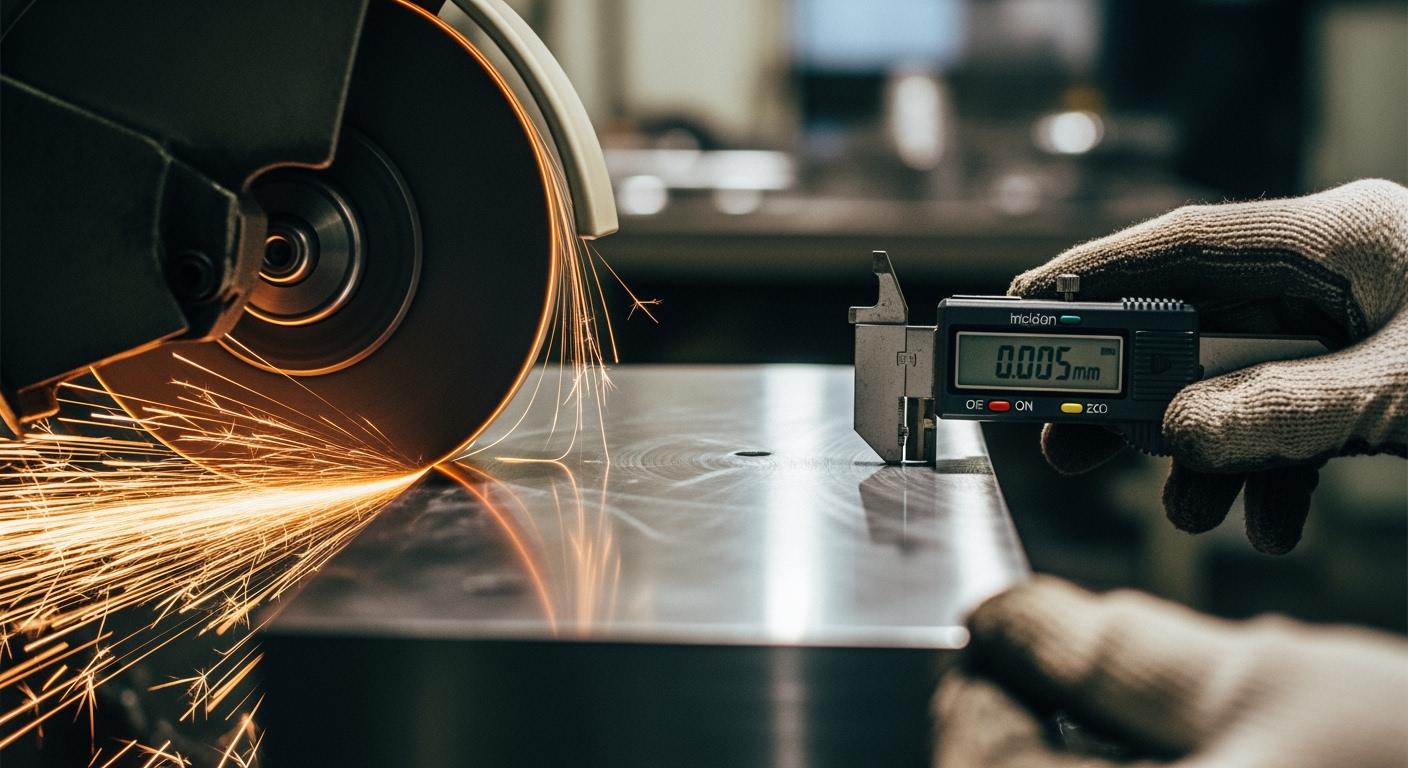
You achieve the best results in grinding hardened die steel when you balance efficiency with surface quality. Choosing the right abrasive and optimizing grinding parameters helps you reach this goal. For example, changing the depth of cut from 20 to 40 μm can improve efficiency by lowering specific grinding energy from 32.34 to 17.46 J/mm³, but it may increase surface roughness from 0.62 to 0.92 μm. Aimgrind offers customized solutions that help you make smart choices. You can focus on actionable steps and keep improving your process.
Key Takeaways
- Choose the right abrasive grain type to improve surface quality and efficiency. Superabrasives like diamond or CBN provide the best results.
- Adjust grinding parameters such as stepover, feed rate, and depth of cut to balance efficiency and surface quality. Start with semi-finishing values for best results.
- Use effective coolant methods like Minimum Quantity Lubrication (MQL) to reduce heat and improve surface finish. Regularly check coolant quality for optimal performance.
- Dress your grinding wheel frequently to maintain sharpness and ensure consistent surface quality. This prevents dull grains from affecting your results.
- Continuously monitor and improve your grinding process. Regular maintenance and parameter adjustments lead to better efficiency and higher quality surfaces.
Abrasive Selection for Steel Grinding
Grain Types and Surface Quality
You need to choose the right abrasive grain for grinding hardened die steel. The grain type affects how the wheel cuts and the quality of the surface you get. Here are some common abrasive materials:
- Aluminum oxide works well for grinding steel. It gives you good durability and helps the wheel last longer.
- Silicon carbide is harder than aluminum oxide. It wears out faster when you grind steel, so you may need to change the wheel more often.
- Cubic boron nitride and diamond are superabrasives. These grains help you achieve a smooth surface and cut through hard steel quickly.
The grain type changes the surface roughness and the microstructure of the steel. If you use a wheel with the right grain, you can improve fatigue strength and corrosion resistance. You also get better wear resistance. The choice of grain type impacts both how fast you remove material and how good the surface looks after grinding.
Tip: Superabrasive wheels, like those with diamond or CBN grains, give you the best surface finish and high efficiency when you grind hardened die steel.
Wheel Hardness and Structure
The hardness and structure of the wheel matter when you want to balance efficiency and surface quality. Softer wheels work best for grinding hard materials like hardened steel. They let dull grains break away easily, which keeps the wheel sharp and reduces heat. This helps you avoid burning the steel and keeps the grinding process efficient.
You can see how wheel structure affects performance in the table below:
| Wheel Type | Grain Structure | Geometry | Surface Quality | Grinding Force Impact |
|---|---|---|---|---|
| 99 A | Irregular shapes, random form | No repeatability | Higher roughness values, lower cutting efficiency | More sensitive to grinding distance and wear |
| SG | Regular, typically triangular | Predictable geometry with sharp corners | Lower and stable roughness values, superior performance | Less sensitive to grinding distance, consistent high quality |
If you need a fine surface finish, you can use a slightly harder wheel. For most grinding jobs on hardened steel, a softer wheel gives you strong cutting ability and good self-sharpening. You get high efficiency and moderate surface roughness.
Aimgrind Diamond Grinding Wheels
Aimgrind offers customized grinding wheels designed for hardened die steel. You can select diamond grinding wheels to achieve both high efficiency and excellent surface quality. Diamond is the hardest known material. It lets you grind tough steel without dulling the wheel. You get fast material removal and a smooth finish.
Aimgrind diamond grinding wheels come in different bond types, such as resin, metal, and vitrified. You can match the wheel to your grinding needs. For example, resin bond wheels work well for high-speed grinding. Metal bond wheels give you precision and durability. Vitrified bond wheels offer stability and consistent performance.
When you choose a wheel from Aimgrind, you get a product that fits your equipment and process. You can use diamond wheels for cemented carbides, ceramics, and composites. Fine diamond grits help you reduce micro-chipping and improve surface quality. Aimgrind helps you select the right wheel by balancing hardness, toughness, and friability. This extends tool life and improves efficiency.
Note: Aimgrind’s service includes problem diagnosis and sample optimization. You get a wheel that matches your steel hardness and grinding requirements.
You can use the following guidelines to match abrasive type to steel hardness:
- For cemented carbides and tungsten carbide, diamond wheels penetrate these materials easily.
- For ceramics and glass, fine diamond grits prevent micro-chipping.
- For composites and non-metallic materials, diamond wheels provide high material removal rates.
Choosing the right wheel helps you work faster and achieve the surface quality you need. Aimgrind’s diamond grinding wheels give you the best balance between efficiency and surface finish.
Grinding Parameters to Balance Efficiency
Grinding hardened die steel requires you to adjust several parameters to balance efficiency and surface quality. You can control stepover, feed rate, pressure, depth of cut, and speed. Each parameter affects the grinding process and the final surface. Aimgrind helps you match these parameters to your equipment and material for optimal results.
Stepover and Feed Rate
Stepover and feed rate play a big role in surface grinding. Stepover is the distance the wheel moves sideways after each pass. Feed rate is how fast the wheel moves across the steel. If you set these values too high, you may finish the grinding process quickly, but the surface can become rough. If you set them too low, you get a smoother surface, but the grinding process takes longer.
You can use different values for various grades of hardened die steel. The table below shows typical values for roughing, semi-finishing, and finishing operations:
| Operation Type | Cutting Speed (Vc) | Feed per Tooth (Fz) | Axial Depth of Cut (Ap) | Radial Depth of Cut (Ae) |
|---|---|---|---|---|
| Roughing Operations | 350-450 SFM | 0.004-0.006 IPT | 0.100″-0.200″ | 50%-75% of cutter diameter |
| Semi-Finishing Ops | 450-550 SFM | 0.0025-0.0035 IPT | 0.020″-0.060″ | 25%-40% of cutter diameter |
| Finishing Operations | 500-600 SFM | 0.001-0.002 IPT | 0.002″-0.010″ | 10%-20% of cutter diameter |
You can see that roughing operations use higher feed rates and stepover values. This increases efficiency but may lower surface quality. Finishing operations use lower values to improve surface quality. Aimgrind recommends adjusting these values based on your steel grade and desired finish. You can balance efficiency by choosing the right stepover and feed rate for each grinding process.
Tip: Start with semi-finishing values if you are unsure. You can adjust up or down to balance efficiency and surface quality.
Pressure and Depth of Cut
Pressure and depth of cut affect the grinding process and the surface. If you increase the pressure or depth of cut, you remove more material quickly. This boosts efficiency, but it can change the surface quality. Studies show that increasing depth of cut leads to higher cutting forces and temperatures. This can cause more compressive residual stresses on the surface or sometimes less, depending on other factors.
The table below summarizes research findings:
| Study | Findings |
|---|---|
| Agrawal and Joshi (2013) | Residual stresses become more compressive with increasing cutting depth due to the expansion of the compression zone on the machined surface. |
| Yao et al. (2013) | Increasing cutting depth leads to greater chip deformation and increased friction, resulting in higher cutting forces and temperatures. |
| Ding et al. (2017) | Higher cutting forces induce greater deformation of the workpiece’s surface layer, contributing to higher-magnitude compressive residual stresses. |
| El-Axir et al. (2017) | Reports a trend where residual stresses become less compressive with higher cutting depths. |
| Saini et al. (2013) | Similar findings regarding the reduction of compressive residual stresses with increased cutting depth. |
| Tomaz et al. (2019) | Correlation between residual stress and cutting depth is complex and influenced by other variables. |
| Snoeys et al. (1978) | Studied the effect of feed rate on residual stresses, noting that increased feed speed led to more compressive residual stresses. |
You can use moderate pressure and depth of cut to balance efficiency and surface quality. If you want a finer surface, reduce the depth of cut and pressure. Aimgrind’s experts help you match these parameters to your grinding wheel and steel type. You can improve the grinding process by monitoring the surface and adjusting as needed.
Note: Always check the surface after each grinding process. You can change the depth of cut or pressure to balance efficiency and surface quality.
Speed Control for Surface Grinding
Speed control is important for surface grinding. If you increase the wheel speed, you can improve surface quality. Higher speeds reduce surface roughness and help you achieve a finer finish. Research shows that increasing cutting speed leads to better surface quality because it softens the steel at the shear plane. This reduces cutting forces and prevents built-up edges.
A novel grinding method, dual electrolytic grinding, showed that optimal speed and voltage can achieve a surface roughness as low as 2.5 nm. This method also prevents wheel loading and improves surface quality. You can use higher speeds to balance efficiency and surface quality in your grinding process.
Aimgrind recommends starting with moderate speeds and increasing gradually. You can monitor the surface and adjust speed to balance efficiency. Aimgrind’s service helps you match wheel speed to your steel and grinding process for the best results.
Tip: If you notice poor surface quality, try increasing the wheel speed. You can achieve a smoother surface and balance efficiency.
You can balance efficiency and surface quality by adjusting stepover, feed rate, pressure, depth of cut, and speed. Aimgrind’s expertise in parameter matching ensures you get the best results for your grinding process. You can optimize each step and achieve high efficiency and excellent surface quality in surface grinding.
Coolant and Dressing Techniques
Coolant Delivery for Steel Grinding
You need to use the right coolant method to keep your grinding process efficient and your surface finish high. Clean and well-placed coolant helps you control heat and protect your grinding wheel. Researchers have found that Minimum Quantity Lubrication (MQL) improves surface roughness, lowers cutting temperatures, and increases tool life. You also get better dimensional accuracy with MQL compared to traditional flooded methods.
- MQL reduces tool wear and gives you a better surface.
- Clean coolant extends the life of your grinding wheel and keeps your process stable.
- Good coolant delivery lowers machine maintenance and boosts production rates.
- Placing coolant correctly helps manage heat and improves the quality of your finished surface.
Some advanced methods, like Indirect Cooling Grinding (I.C.G.), avoid direct contact between coolant and the workpiece. This helps prevent oxidation and surface hardening. Air or mist coolant works well for chip removal and keeps your grinding wheel sharp.
Tip: Aimgrind recommends regular checks on coolant quality and delivery systems to keep your grinding process smooth.
Wheel Dressing for Surface Quality
You must dress your grinding wheel often to keep your surface finish consistent. Dressing removes dull grains and exposes fresh cutting edges. This keeps your grinding wheel sharp and ready for each job. The table below shows how dressing improves surface roughness and affects the G-Value, which measures wheel life:
| Trial Set | Wheel Type | Surface Roughness Improvement | G-Value Impact |
|---|---|---|---|
| 7 | Type B | Significant improvement | Decreased by 75% |
| 5 | Type A | Moderate improvement | Decreased by 50% |
You can use different dressing techniques, such as truing and dressing, to restore your wheel’s shape and sharpness. Rotary diamond dressers and stationary diamond tools work well. Adjusting dresser speed, depth, and frequency helps you get the best surface finish.
Note: Aimgrind suggests frequent dressing for hardened steel to keep your grinding wheel in top condition.
Minimizing Heat and Vibration
You need to control heat and vibration to protect your grinding wheel and get a smooth surface. High heat can damage your workpiece and your wheel. Vibration can cause uneven grinding and poor surface quality. Research shows that using ultrasonic vibration-assisted grinding reduces both heat and vibration. This method helps you achieve a better surface and extends the life of your grinding wheel.
Practical tips for you:
- Use optimized coolant application.
- Reduce the depth of cut when you see too much heat.
- Dress your grinding wheel often to keep it sharp.
- Try cryogenic cooling for very sensitive materials.
Remember: Keeping your grinding wheel cool and stable leads to better surface quality and higher grinding efficiency.
Ongoing Improvement in Surface Grinding
You need to keep improving your grinding process to get the best results for hardened steel. Ongoing improvement helps you maintain high part quality, surface finish, and strength. Aimgrind supports you with a full service process. You get help with problem diagnosis, parameter matching, and sample optimization. This makes your surface grinding more reliable and efficient.
Equipment Maintenance
You should check your grinding machine and tools often. Clean the machine and remove any dust or debris. Lubricate moving parts to reduce wear. Replace worn grinding wheels before they affect surface quality. Tighten bolts and check for loose parts. Good maintenance keeps your steel grinding process stable and protects the strength of your parts.
Tip: Schedule regular checks for your coolant system and wheel dressing tools. This keeps your grinding setup ready for every job.
Monitoring Surface Quality
You can use different methods to check the surface after grinding. These methods help you see if your process gives you the right finish and part quality. The table below shows common ways to monitor surface quality:
| Method | Findings |
|---|---|
| Confocal Microscopy | Analyzes surface topography and roughness metrics, showing a link between parameters and surface structure. |
| Scanning Electron Microscopy (SEM) | Shows thinner and clearer grinding marks at higher speeds, which means better surface quality. |
| Atomic Force Microscopy (AFM) | Measures surface roughness and confirms that higher speeds improve surface quality and reduce breakout. |
You can also use stylus profilometers and optical systems to measure roughness. Metallographic and electron microscopes help you find microcracks or burns in steel. These checks make sure your surface grinding process gives you the finish and strength you need.
Troubleshooting Grinding Issues
You may see problems like grinding burn, microcracks, or poor finish during surface grinding. These issues can lower part quality and strength. You can spot them by looking for discoloration, cracks, or rough areas on the steel surface. Use the strategies in the table below to solve common grinding problems:
| Strategy Type | Recommendations |
|---|---|
| Thermal Control | Keep coolant flow between 8–15 L/min with direct nozzle impact. Lower depth of cut below 0.01–0.02 mm for finishing. Keep wheel speed at 25–30 m/s. |
| Wheel Conditioning and Stability | Dress the wheel often to restore sharpness. Use open-structure wheels for ductile steel. Lower feed rate if chips build up. |
| Setup Control | Minimize wheel overhang. Clamp workpieces tightly. Adjust spindle speed away from vibration zones. Lower infeed below 0.01 mm for final passes. |
You can improve your grinding process by adjusting parameters and checking results. Studies show that optimizing grinding parameters and dressing wheels often leads to better surface quality, lower energy use, and longer tool life. Aimgrind helps you with ongoing support and advice for every step of your surface grinding process.
Remember: Continuous improvement keeps your grinding process strong and your steel parts at top quality.
You can achieve top results in grinding hardened die steel by following four key steps. Choose the right abrasive, set the best parameters, manage coolant and dressing, and keep up with maintenance. The table below shows how each step brings clear benefits:
| Optimization Strategy | Benefit |
|---|---|
| Abrasive Selection | Matches grit and bond for effective grinding |
| Parameter Optimization | Improves efficiency with the right speeds and feeds |
| Coolant Management | Prevents heat damage and boosts surface quality |
| Wheel Truing and Dressing Techniques | Keeps the wheel sharp for better performance |
Aimgrind’s diamond grinding wheels and custom solutions help you get consistent, high-quality surfaces. For example, one automotive parts maker saw a 45% drop in downtime and a 30% better surface finish. A stainless steel plant gained 50% longer tool life and cut costs by 20%. Keep applying these steps and always look for ways to improve your process.
FAQ
What is the best abrasive for grinding hardened die steel?
You should use diamond or CBN grinding wheels. These superabrasives cut hard steel quickly and give you a smooth surface. Aimgrind offers custom diamond wheels for the best results.
How often should you dress your grinding wheel?
You should dress your grinding wheel before each new job or when you notice a drop in surface quality. Regular dressing keeps the wheel sharp and improves grinding efficiency.
Why does coolant matter in surface grinding?
Coolant keeps your grinding wheel and steel cool. It reduces heat, prevents burns, and helps you get a better surface finish. Clean coolant also extends the life of your grinding wheel.
How do you check surface quality after grinding?
You can use tools like stylus profilometers or microscopes. These tools measure roughness and help you see if your grinding process gives you the finish you want.
Contact Us
For More Grinding Solution or Customized Abrasive Tools