

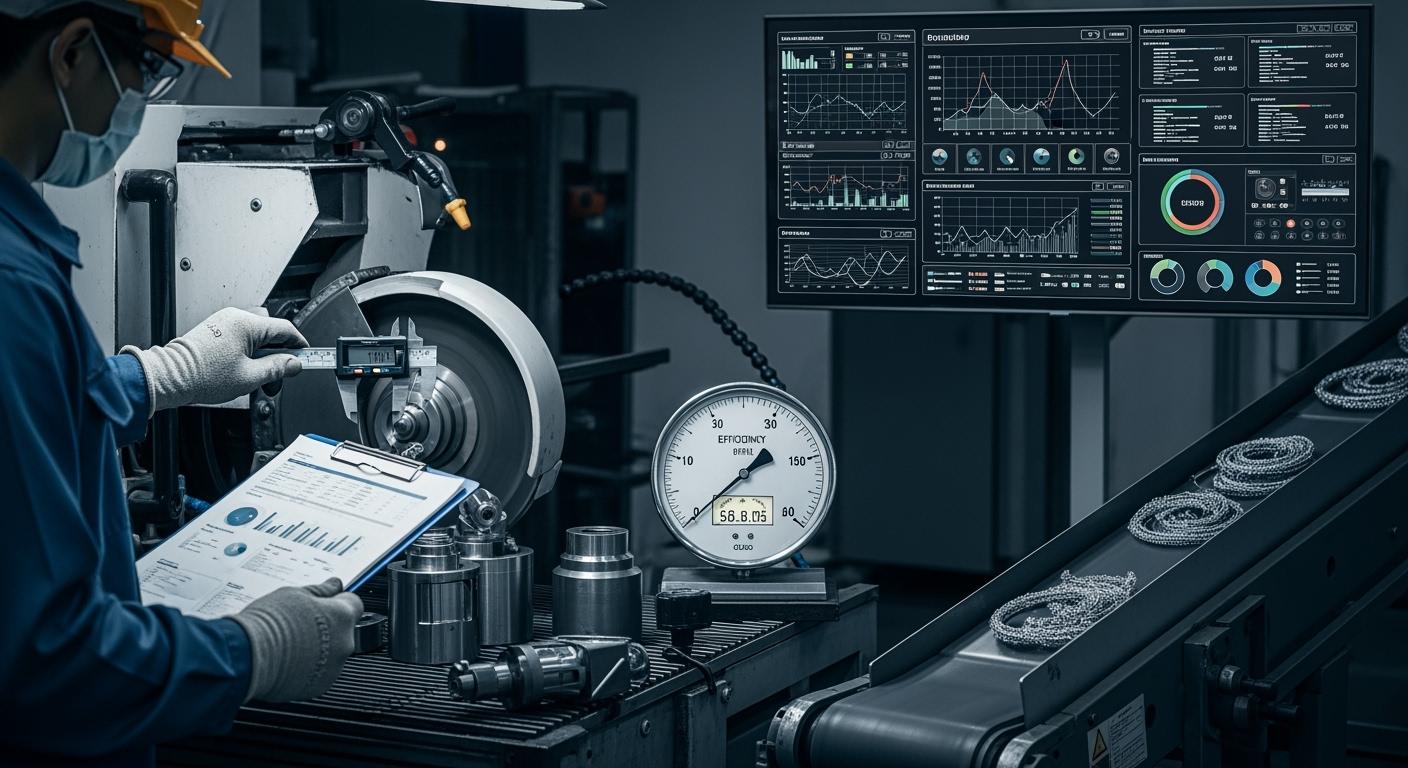
You can measure grinding efficiency by tracking how much material you remove and how much energy your equipment uses. Using the right tools matters. Aimgrind offers diamond grinding wheels that help you achieve faster cutting and longer wheel life. These wheels also reduce dust emissions and cut down on replacement frequency. See the table below for a quick comparison:
| Performance Metric | Traditional Resin Bond Wheels | Brazed Diamond Grinding Wheels |
|---|---|---|
| Wheel Lifespan | Up to 15 hours | Up to 50 hours |
| Cutting Efficiency | Moderate | High (20-30% faster cycle times) |
| Replacement Frequency | Every 2-3 shifts | Every 6-8 shifts |
| Dust Emissions | High | Significantly Reduced (up to 40% less) |
You need ongoing optimization and the right grinding wheels to improve productivity and quality.
Key Takeaways
- Measuring grinding efficiency helps you save energy and reduce costs. Track energy use and material removal to identify areas for improvement.
- Upgrading to Aimgrind’s diamond grinding wheels can significantly enhance your grinding process. These wheels offer longer lifespan and better cutting efficiency.
- Regularly monitor grinding parameters like wheel speed and feed rate. Adjusting these can lead to better control and improved product quality.
- Implement real-time monitoring systems to catch issues early. This helps maintain efficiency and ensures consistent performance.
- Invest in staff training to improve operational efficiency. Well-trained employees can make fewer mistakes and enhance productivity.
Why Grinding Efficiency Matters
Cost and Productivity Impact
You need to focus on grinding efficiency because it directly affects your costs and how much you can produce. When you improve grinding efficiency, you use less energy and reduce machine wear. This means you spend less money on electricity and equipment repairs. In many industries, energy costs can make up 30-40% of your total expenses. For example, in the cement industry, grinding can use up to 60% of all electrical energy. You also save money by reducing the need to replace worn parts, which can be very expensive in mineral processing.
- Grinding efficiency helps you:
- Lower your energy bills.
- Cut down on repair and replacement costs.
- Produce more parts in less time.
- Reduce waste and machine downtime.
Manufacturers like you choose to improve grinding efficiency to boost productivity and save money. You get faster cycle times, better use of your machines, and less waste. Aimgrind supports you with advanced grinding solutions that help you reach these goals.
Quality and Sustainability
Grinding efficiency also plays a big role in the quality of your products and your impact on the environment. When you use efficient grinding methods, you get smoother surfaces and fewer defects. This means you spend less time fixing mistakes and more time making high-quality parts. You can achieve this by choosing the right wheel speed, using proper coolant delivery, and making sure your machines are strong and powerful.
Tip: Upgrading to Aimgrind’s diamond grinding wheels can help you maintain high grinding efficiency, which leads to better product quality and less waste.
Here is how grinding efficiency supports sustainability:
| Benefit | Description |
|---|---|
| Energy Consumption | You use less energy, which lowers costs and supports green goals. |
| Waste Minimization | You use fewer liners and parts, so you create less waste. |
| Resource Utilization | You get more out of your materials and machines, helping the environment. |
| Emission Reduction | You produce fewer emissions, which is better for the planet. |
Aimgrind believes in quality and innovation. The brand’s grinding wheels help you meet your production targets while supporting sustainability and high standards.
How to Measure Grinding Efficiency
Key Metrics and Methods
You need to measure grinding efficiency to improve your process and get the best results. Start by looking at the most widely accepted metrics in the industry:
- The work index (Wi) helps you compare the efficiency of different mills.
- Wio and Wioc calculations show how well a single-stage ball mill performs.
- The Bond work index equation gives you a way to check grinding mill performance and understand how your plant works.
You can also use a signature plot. This graph shows net specific energy versus grinding size (P80) at different slurry solids percentages. You will see that grinding efficiency improves as you increase slurry solids, but only up to a certain point. After that, efficiency drops.
You should always use grindability test results to check your process. These results tell you how hard it is to grind a material and how much energy you need. When you measure grinding efficiency, you can spot problems early and make changes before they affect your output.
Using Power Consumption and Q’
Power consumption is a key metric for grinding efficiency measurement. You can track how much energy your grinding machine uses for each ton of material. This helps you find out if your process is running well or wasting energy. The table below shows important power-related metrics:
| Metric | Description |
|---|---|
| Specific Energy Consumption | Amount of energy required to process one ton of material to a specific fineness (kWh/ton). |
| Motor Efficiency | Efficiency of the motor used in the grinding process, impacting overall energy use. |
| Auxiliary Equipment Consumption | Energy consumed by additional equipment that supports the grinding process. |
You should also use the Q’ index. This index shows the amount of material you remove per unit of energy. When you combine power readings with grindability test results, you get a clear picture of your grinding process. You can use these numbers to measure grinding efficiency and make smart changes.
Tip: Always record your grindability test results and power readings. This helps you track changes and see if your process is improving.
Benchmarking with Aimgrind Tools
You can use Aimgrind’s diamond grinding wheels to get accurate and repeatable grindability test results. These wheels keep their shape and sharpness, so your measurements stay consistent over time. When you use high-quality tools, you can trust your grinding efficiency measurement.
Aimgrind’s diamond grinding wheels help you measure grinding efficiency in real-world conditions. You can compare your grindability test results before and after switching to Aimgrind wheels. Many users see better energy use and faster material removal. You can also use these wheels to test different machine settings and find the best setup for your process.
You should always measure grinding efficiency with the right tools. Aimgrind gives you the products and support you need to get reliable results and improve your operation.
Factors Affecting Grinding Efficiency
Material and Feed Properties
You need to understand how the properties of your materials and the mill circuit feed impact the grinding process. The main factors affecting grinding include:
- Density: This changes how much impact energy you need and affects energy consumption.
- Hardness: Harder materials keep their shape and help you use the grinding process more efficiently.
- Wear Resistance: Materials that resist wear help keep the grinding media in good condition.
- Toughness: Tough materials do not chip or break easily during the grinding process.
- Corrosion Resistance: This stops the material from breaking down and keeps your products clean.
- Material Purity: Pure materials lower the risk of contamination.
You should always check the properties of your mill circuit feed before starting. If you notice changes in density or hardness, adjust your grinding process to keep your operating work index steady.
When you increase the feed rate, you can remove more material and make the grinding process faster. But if you go too fast, you might see more heat and lose control over the finish.
Equipment and Diamond Grinding Wheels
The type of equipment you use makes a big difference in grinding efficiency. Surface grinders, centerless grinders, and precision machines all handle the grinding process in different ways. Automated machines can help you work faster, but you need to make sure they still meet your accuracy needs. Precision grinding machines are best for industries that need tight tolerances, like aerospace.
Aimgrind’s diamond grinding wheels help you get better results. These wheels keep their shape and sharpness, so you get a steady operating work index and lower energy consumption. Some machines have cooling systems to stop heat from building up, which helps you avoid mistakes in your final product.
You should match your grinding equipment and wheels to the type of mill circuit feed you have. This helps you get the best results from your grinding process.
Operational Parameters
You control many parameters during the grinding process. These include wheel speed, feed rate, depth of cut, and coolant flow. Each one changes how well your grinding process works.
| Parameter | Effect on Grinding Efficiency |
|---|---|
| Wheel Speed | Higher speeds remove more material but can cause more heat. |
| Feed Rate | Faster feeds make cycles quicker but may lower finish quality. |
| Depth of Cut | Removing 0.25–0.50 mm at a time gives you better control. |
| Coolant Flow | Good cooling stops burns and keeps tight tolerances. |
You should also watch the mill circuit feed rate and keep it steady. If you change it too much, you can starve or choke the mill. Keep the pulp density between 65-75% solids by weight for the best grinding process. Set your mill rotation speed at about 72-78% of critical speed to get the best motion.
Tip: Adjust your wheel speed based on the material. Softer materials need lower speeds, while harder ones need higher speeds.
By checking these factors often, you can keep your grinding process efficient, lower energy consumption, and maintain a steady operating work index.
Improve Grinding Efficiency with Aimgrind Solutions
Optimizing Parameters and Angles
You can boost grinding efficiency by adjusting key parameters and angles in your operation. Start by updating ore hardness data as your mine changes. Use this information to set mill speed, feed rate, and media loading. Design your mills with feed size, ore hardness, and throughput targets in mind. Variable speed drives let you change mill speed based on feed characteristics. Optimize ball size distribution for better impact efficiency. Monitor media wear and add new media when needed.
- Adjust mill speed to 70-80% of critical speed for the best grinding action.
- Keep the charge level right to avoid media damage and ensure effective grinding.
- Control feed rate to keep your mill steady and prevent overloading.
- Watch cyclone feed pressure and adjust apex or spigot size for good classification.
You can also use real-time measurement tools to check particle size and mill load. Advanced control systems like Model Predictive Control help you make dynamic adjustments. Digital twins let you simulate and optimize your grinding process. These steps help you maximize throughput and improve performance.
Tip: Regular monitoring and adjustment of grinding parameters lead to consistent results and higher plant throughput.
Upgrading to Diamond Grinding Wheels
Switching to Aimgrind’s diamond grinding wheels gives you a clear advantage in grinding process optimization. Brazed diamond wheels improve machining for hard-to-machine materials. Advanced vacuum brazing technology ensures strong adhesion of diamond particles. High-purity diamonds boost cutting performance and extend wheel lifespan.
| Metric | Improvement |
|---|---|
| Material Removal Rate | Up to 1.8-fold increase |
| Diamond Consumption | Up to 1.9-fold decrease |
| Cost Reduction | Nearly 10-fold reduction |
You see faster material removal and lower diamond consumption. This means you spend less on replacements and reduce downtime. Applying a periodic load with controlled amplitude and frequency increases efficiency. You get higher material removal rates and lower processing costs. Aimgrind’s diamond grinding wheels maintain their shape and sharpness, which leads to steady performance and better throughput.
Note: Upgrading your grinding wheels is a simple step that delivers measurable improvements in performance and plant throughput.
Process Control and Staff Training
You need strong process control and well-trained staff to reach peak performance. Real-time control systems stabilize your grinding operation. These systems increase ore throughput, reduce mill load variability, and improve metal recovery. You also see less grinding media consumption and more stable cyclone pressure.
| Benefit | Percentage Improvement |
|---|---|
| Gain in ore throughput | 1–16% |
| Reduction in mill load variability | 40% |
| Increase in metal recovery | up to 1% |
| Reduction in grinding media consumption | 15% |
| Reduction of cyclone pressure variability | 52% |
| Greater process stability | 71% |
| Throughput gain | 54% |
| Energy consumption reduction | 50% |
| Increase yield of valuable products | 43% |
| Operating labour reduction | 30% |
| Downtime reduction | 21% |
| Better plant safety | 16% |
Regular training ensures your team follows best practices. Well-trained employees make fewer mistakes and work more efficiently. You see higher productivity and lower operational costs. Aimgrind supports you with guidance and technical expertise. You can rely on Aimgrind’s solutions to help your staff achieve the best results.
Callout: Invest in process control systems and staff training to unlock the full potential of your grinding operation and maximize throughput.
You can combine parameter optimization, equipment upgrades, and staff training to achieve outstanding performance. Aimgrind’s diamond grinding wheels and expert support help you reach your goals in grinding process optimization.
Validating and Monitoring Improvements
Conducting Grinding Tests
You need to validate your grinding improvements with careful testing. Start by using the finest grit size to create a flat surface and remove any sectioning marks. For rough surfaces, use abrasive grit sizes between 180 and 240. Move to smaller grit sizes step by step, such as 240, 320, 400, and 600. Always grind wet to keep the surface cool and prevent the abrasive from clogging. Make sure each step removes the damage from the previous one. If you use automated grinding, begin with planar grinding to set a common plane for all samples.
Follow these steps to get reliable results:
- Collect historical maintenance and process data.
- Visit your site to prepare quality data and solve problems.
- Analyze operating data from your control system.
- Define a clear scope for your optimization work.
- Talk with your team to learn about site challenges.
Regular grinding tests give you important numbers like Q-prime and G ratio. These numbers help you see how well your process works and where you can improve. When you adjust your grinding based on test results, you boost efficiency and stay competitive.
Continuous Monitoring and Audits
You should use technology to track your grinding process in real time. Modern systems measure vibration, temperature, pressure, and power use. These tools help you spot problems early and make quick changes. For example, the SmartMill™ Optimization System uses sensors to check particle size and mill load. Online particle size analyzers use lasers and sound to measure particles as you grind. Mill power sensors and media wear monitors help you keep your process steady.
| Technology | Description |
|---|---|
| SmartMill™ Optimization System | Tracks process data and predicts changes using sensors and analytics. |
| Online Particle Size Analyzers | Measures particle size in real time with lasers and sound. |
| Mill Power Sensors | Estimates grinding charge and load for better control. |
| Sensor-based Media Wear Monitors | Checks wear on grinding media to optimize performance. |
Tip: Advanced dashboards show your key numbers in real time. This helps you make smart decisions and keep your process running smoothly.
Regular audits and continuous monitoring help you see real progress. You can compare your results before and after making changes. For example, after improvements, you may see higher efficiency and lower energy use.
You should keep testing and monitoring to make sure your grinding stays efficient and productive.
You can achieve top grinding efficiency by focusing on the right actions. The table below shows proven ways to boost efficiency:
| Technique | How It Improves Efficiency |
|---|---|
| Pre-classification of feed | Keeps efficiency high by ensuring steady material input |
| Grinding media selection | Increases efficiency through better energy transfer |
| Mill parameter optimization | Raises efficiency by adjusting speed and loading |
| Advanced control systems | Maintains efficiency with real-time adjustments |
| Innovative design modifications | Expands efficiency by reducing retention time |
To keep efficiency strong over time, follow these steps:
- Evaluate your current process for efficiency gaps.
- Upgrade to Aimgrind’s diamond grinding wheels for better efficiency.
- Optimize coolant and grinding parameters to protect efficiency.
- Maintain and clean equipment to preserve efficiency.
- Train your team to understand efficiency best practices.
Aimgrind helps you reach new levels of efficiency with custom solutions. Keep monitoring your process and seek expert support to ensure lasting efficiency gains.
FAQ
What is grinding efficiency and why does it matter?
Grinding efficiency shows how well you turn raw material into finished parts. You save energy and time when you improve grinding. You also get better product quality. High grinding efficiency means you use less power and reduce waste.
How do you measure grindability in your process?
You measure grindability by testing how much energy you need to grind a material to a certain size. You use special tests and tools. Grindability helps you pick the right grinding wheels and set the best machine settings for your job.
Why should you choose diamond grinding wheels for tough materials?
Diamond grinding wheels work best for hard materials like ceramics and alloys. You get faster grinding, longer wheel life, and smoother finishes. These wheels keep their shape and help you control grinding quality. You also see less downtime for wheel changes.
How often should you check grinding parameters?
You should check grinding parameters every shift or after any change in material or machine setup. Regular checks help you spot problems early. You keep grinding efficiency high and protect your equipment from damage.
What are the main factors that affect grindability?
Grindability depends on material hardness, density, and structure. You also need to look at feed size and moisture. When you know the grindability, you can adjust grinding speed, wheel type, and feed rate for better results.
Tip: Always test grindability before starting a new grinding job. This helps you avoid mistakes and get the best performance.
Contact Us
For More Grinding Solution or Customized Abrasive Tools