

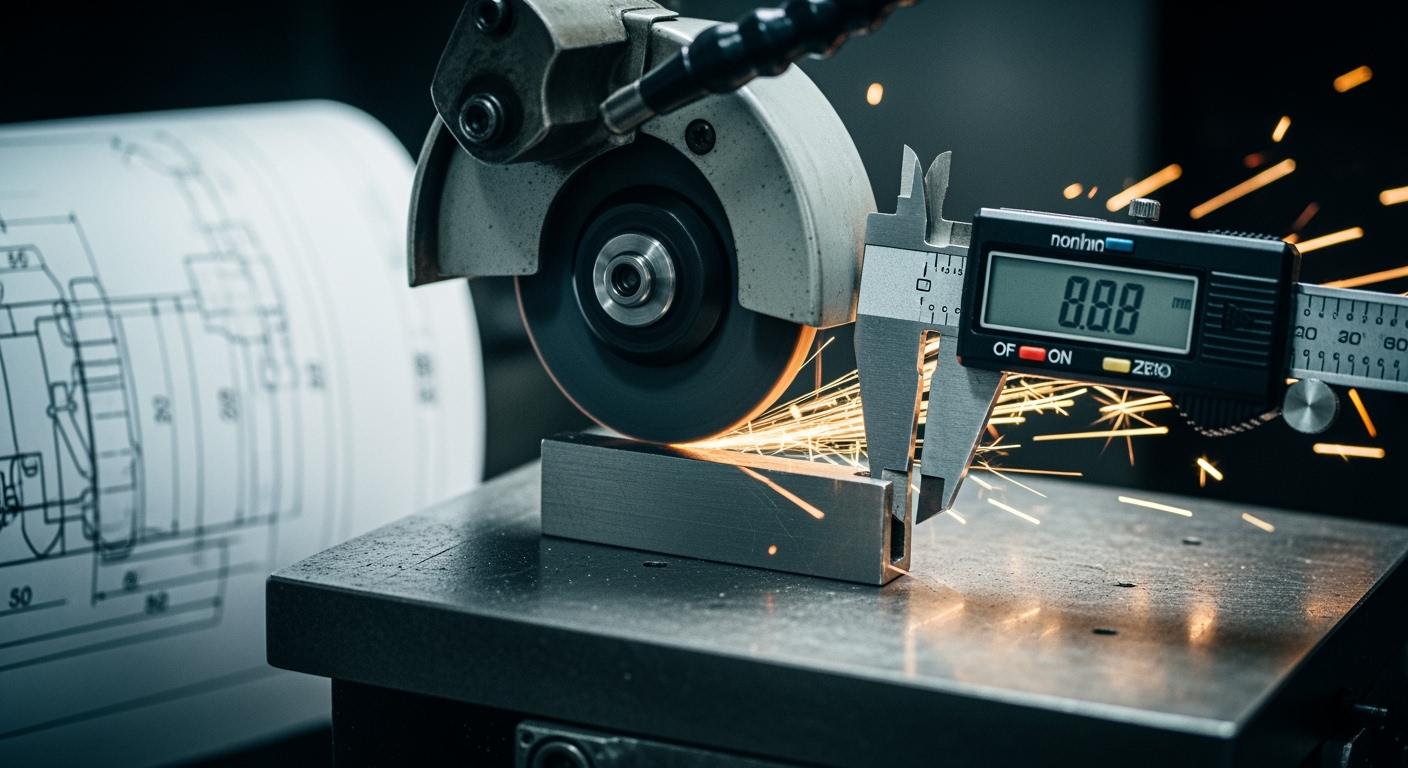
You can control dimensional accuracy and flatness in the grinding process by making smart choices. Start by selecting the right grinding wheel, such as Aimgrind diamond grinding wheels, which give you precise results for hard materials. Focus on key process parameters. For example, the speed of the rotary table affects flatness more than the allowance value. The normal grinding force changes how flat your workpiece will be.
| Parameter | Impact on Flatness Deviation |
|---|---|
| Speed of rotation of rotary table | Greater influence on height and flatness deviation |
| Value of allowance | Smaller influence compared to feed speed of workpiece |
| Normal component of grinding force | Affects deformation of machining system, increasing deviations in height and flatness |
You should also keep your machines well-maintained and use advanced measurement tools. Regular monitoring helps you spot changes before they cause problems. With these steps, you can achieve the best results in every grinding task.
Key Takeaways
- Select high-quality grinding wheels, like Aimgrind diamond wheels, for better precision and efficiency.
- Regularly calibrate your grinding machine every three to six months to maintain accuracy.
- Monitor and adjust process parameters in real-time to minimize errors and improve flatness.
- Use advanced measurement tools to check dimensions during grinding for immediate corrections.
- Implement a regular maintenance plan to keep machines in top shape and avoid deviations.
Key Factors in Dimensional Accuracy and Flatness
Machine Rigidity and Calibration
You need a rigid machine to achieve high dimensional accuracy in grinding. A strong machine frame reduces vibration and keeps the grinding wheel steady. Vibration can cause errors in flatness and size. You should check and calibrate your grinding machine often. Most manufacturers recommend calibration every three to six months. If you use your machine a lot, you may need to calibrate it more often. Always follow the calibration schedule in your machine’s manual. Regular calibration helps you keep your process parameters under control and ensures your results stay consistent.
Tip: Start with the manufacturer’s calibration standards and adjust based on your production needs.
Grinding Wheel Selection (Aimgrind Diamond Grinding Wheels)
Choosing the right grinding wheel is very important for both flatness and dimensional accuracy. Aimgrind diamond grinding wheels give you high grinding efficiency and stable dimensions. These wheels work well on tough and brittle materials. They keep their shape and sharpness, so you get consistent results.
| Advantage | Description |
|---|---|
| High Grinding Efficiency | Engineered with industrial-grade diamond powder for precision. |
| Stable Dimensions | Maintains consistent dimensions during grinding processes. |
| Precision on Tough Materials | Capable of grinding tough and brittle materials effectively. |
You should also pay attention to grit size and bond type. For example, a metal bond with a grit size of 76 μm will show a decrease in surface parameters as it wears. If the bond clogs, the surface can become uneven. Aimgrind offers different bond types and grit sizes to match your process parameters and material needs.
| Grit Size (μm) | Bond Type | Surface Parameter (S_pk) | Surface Parameter (S_vk) |
|---|---|---|---|
| 76 | Metal | Decreases with wear | Fluctuates due to clogging |
| 64 | Metal | Decreases with wear | Increases with clogging |
Process Parameters and Control
You must set your process parameters carefully to control dimensional accuracy and flatness. These include feed rate, depth of cut, and workpiece velocity. For example, a feed rate of 4 mm per stroke and a depth of cut of 0.01 mm can help you achieve a surface roughness of 0.49 mm. Keeping your table travel speed at 10 m/min and your table cross feed at 0.03 m/min can reduce errors to less than 1%.
| Parameter | Value |
|---|---|
| Feed Rate | 4 mm/stroke |
| Depth of Cut | 0.01 mm |
| Workpiece Velocity | 10 m/min |
| Surface Roughness (Ra) | 0.49 mm |
| Percentage Error | 0.75% |
You can improve flatness by adjusting process parameters in real time. For example, you can change the depth of cut based on measured force. This method helps you correct errors as they happen and reduces the need for extra grinding passes. You save time and get better results.
- Optimize process parameters to minimize thermal damage.
- Monitor and adjust process parameters during grinding.
- Use real-time control to keep flatness within tight limits.
Workholding and Fixturing
You need good workholding to keep your part flat during grinding. Use vises with soft jaws for prismatic parts. Fixture plates with toe and edge clamps work well for large or thin pieces. Vacuum fixtures are best for thin, flat parts because they apply even pressure. Step clamps are flexible for odd shapes, but they take longer to set up. For brittle materials, use low-profile soft-face clamps to spread the load.
- Clean all contact surfaces before clamping.
- Use hard locators like pins and fences to control placement.
- Keep stack height low to reduce distortion.
- Program gentle cutting forces and use probing to check flatness.
Coolant and Thermal Management
Coolant plays a big role in controlling heat during grinding. Too much heat can cause the part to expand and lose flatness. Oil-based coolants work best for hard materials like carbide. They reduce friction and heat, which helps you keep dimensional accuracy. Water-miscible coolants remove heat well but need more care to prevent bacteria.
To combat thermal drift, use coolant circulation channels in the spindle housing. This keeps the temperature even and reduces deformation, so you maintain grinding accuracy.
You should always check coolant flow and temperature as part of your process parameters. Good coolant management helps you avoid thermal distortion and keeps your grinding results consistent.
Monitoring and Measuring Dimensional Accuracy
You need to monitor and measure your grinding process to keep dimensional accuracy and surface finish within tight limits. Regular inspection helps you catch problems early and avoid costly mistakes. Aimgrind supports you with process optimization and sample testing, so you can achieve the best finish and accuracy for every part.
In-Process Measurement Tools
You can use in-process measurement tools to check your work while grinding. These tools help you make quick adjustments and keep your process on track. Some of the most widely used tools include:
- Laser triangulation sensors, like the Keyence LJ-V 7020 K, give you repeat accuracy up to 98.5%. You can trust these sensors to measure the grinding wheel and part during the process.
- In-process verification systems check the outer diameter of parts, such as tapered roller bearings. These systems work with tight design tolerances, like ±0.025 mm, so you can control the grinding process in real time.
When you use these tools, you reduce the risk of errors and improve your surface finish. You also save time because you do not need to stop the machine for every check.
Post-Process Inspection Methods
After grinding, you must inspect your parts to confirm dimensional accuracy and surface finish. You can use several inspection methods to check flatness and finish. The table below shows some common tools and how they work:
| Method | Description |
|---|---|
| Feeler Gauge | Measures flatness by sliding strips of known thickness under the part. |
| Height Gauge | Uses a dial indicator to find the highest and lowest points on the surface. |
| CMM (Coordinate Measuring Machine) | Measures flatness with high precision; you must select the right points for accuracy. |
| 3D Laser Scanner | Scans the whole surface, giving you a detailed map of flatness and finish. |
You should choose the inspection method that matches your part size, shape, and required finish. For high-precision grinding, CMMs and 3D scanners give you the most reliable results.
Surface Finish and Flatness Gauges
You can use tactile gauges to check surface finish and flatness. Machinists often use these gauges to compare the finish of a part to known standards. These gauges help you track the quality of your grinding work. They show roughness amplitudes that match different surface types. You should remember that these measurements are comparative. They give you a quick check, but you need more objective tools for exact finish values.
For better control, use digital surface finish testers. These devices give you numbers for roughness and finish. You can use these numbers to adjust your grinding process and reach your target finish. Always check both the finish and flatness to make sure your parts meet the required standards.
Data Logging and Process Control Systems
You can improve your grinding results by using data logging and process control systems. These systems track every parameter that affects surface finish and dimensional accuracy. When you monitor temperature, you can cut reject rates by up to 20%. Automated cooling and airflow control help you keep tight tolerances and reduce cycle times by up to 25%.
With data logging, you can fine-tune your grinding cycles. You can spot trends and make changes before problems appear. This approach helps you keep your finish and accuracy consistent over time. You also make your process more productive and reliable.
Tip: Use data logging to track your finish, flatness, and dimensional measurement results. This helps you plan machine re-calibration and schedule runout and parallelism test routines.
Regular monitoring and inspection keep your grinding process under control. Aimgrind can help you optimize your process and test samples to reach the best finish and accuracy for your needs.
Detecting and Correcting Flatness Deviations
Common Causes of Flatness Errors
You may see grinding accuracy deviation for many reasons during the grinding process. Some of the most common causes include:
- Wheel breakdown or wear
- Incorrect angle of the regulating wheel
- Problems with wheel shape or composition
- Misalignment of inbound and outbound guides
- Poor balancing of the grinding wheel, which can cause harmonics or undulations
- Improper feed rate settings
- Steady rest set too low, which can change the part shape
- Input chutes not lined up with the grinding path
These issues can change the final shape of your part and lead to flatness problems. You need to watch for these causes to keep your grinding accuracy deviation under control.
Signs and Detection Methods
You can spot grinding accuracy deviation by looking for uneven surfaces or changes in part thickness. Modern detection methods help you find these problems quickly. The table below shows some reliable ways to check for flatness issues:
| Method | Description |
|---|---|
| Laser Scanning | Measures flatness and straightness with high accuracy and speed. |
| Machine Vision Systems | Uses cameras to find surface defects and deviations in real time. |
| Fuzzy Pattern Recognition | Applies smart logic to spot flatness patterns and defects. |
Laser scanning stands out because it gives you millions of data points in seconds. You can use this method for a surface flatness and roughness test. This helps you catch grinding accuracy deviation early and take action before it affects your parts.
Corrective Actions and Process Adjustments
You can correct grinding accuracy deviation by following a few key steps:
- Grind both ends of the part to improve flatness, parallelism, and perpendicularity.
- Remove material in small, careful steps instead of trying to fix everything at once.
- Keep cooling and handling consistent, and store your parts the same way each time.
- Check the end condition and straightness with simple gauges and fixtures.
- Record important details about your process and the checks you complete.
These actions help you correct grinding accuracy deviation and keep your parts within the right limits.
Tip: Always adjust your process as soon as you notice grinding accuracy deviation. Small changes can make a big difference in your results.
Documentation and Root Cause Analysis
You should keep good records of your grinding process. Write down all measurements, machine settings, and maintenance actions. When you see grinding accuracy deviation, use root cause analysis to find out why it happened. This method connects your data with machine conditions and history. You can then correct grinding accuracy deviation faster and prevent the same problem in the future. Good documentation and analysis help you keep flatness consistent over time.
Preventive Maintenance and Process Optimization
Scheduled Maintenance for Grinding Machines
You can keep your grinding machines in top shape by following a regular maintenance plan. This helps you avoid deviation in your results and keeps your manufacturing process smooth. Here are some important steps:
- Inspect critical parts often to catch wear or alignment problems early.
- Check lubrication and cooling systems to make sure your surface grinding machine runs well.
- Look at workrest blades every week to prevent uneven support and part deviation.
- Examine grinding wheel dressers to keep wheel geometry correct and avoid quality loss.
- Listen for strange noises, which can warn you about lubrication or bearing issues.
- Feel for heat in motors and spindles, as this can signal trouble before it gets worse.
When you follow these steps, you reduce the risk of deviation and keep your grinding machines ready for any manufacturing task.
Wheel Dressing and Truing
You need to dress and true your grinding wheels to keep your surface grinding machine working at its best. Dressing sharpens the wheel, while truing keeps its shape. If you dress too much, you waste time and wear out the wheel. If you dress too little, you get poor finishes and risk thermal deviation. The best schedule for dressing and truing depends on how much you use your grinding machines and the conditions in your shop. Check your wheels often and adjust your routine to match your manufacturing needs.
Tip: Regular dressing and truing help you avoid deviation and keep your grinding machines producing high-quality parts.
Parameter Optimization for Surface Finish
You can improve your surface finish by using smart optimization methods. Many experts use advanced algorithms, like NSGA-II with Taguchi modeling, to find the best grinding settings. These methods let you balance several goals at once, such as surface roughness, grinding power, and grinding ratio. When you focus on optimization, you reduce deviation and get better results from your surface grinding machine. This approach helps you reach your manufacturing targets faster and with less waste.
Operator Training and Best Practices
You play a big role in keeping grinding machines accurate. Learn the best ways to set up your surface grinding machine and check for deviation. Always follow the right steps for cleaning, measuring, and adjusting. Share tips with your team to build strong manufacturing habits. When you know how to spot problems and use optimization tools, you help your shop avoid costly mistakes. Good training leads to fewer errors and better results from every grinding job.
Advanced Control Technologies in Grinding
Aimgrind leads the way in innovation and quality for grinding solutions. You can use advanced control technologies to improve surface quality, accuracy, and precision in every grinding task. These tools help you manage parameters, monitor surface finish, and maintain quality control systems for precision manufacturing.
Automated In-Process Measurement
Automated in-process gauging gives you real-time feedback during grinding. Modern systems use CNC controls and sensors to measure surface and part dimensions as you work. For example, LaserUltra technology checks tool geometries to a tolerance of 0.002mm without removing the tool. This reduces measurement time by 70% and boosts accuracy. You can use these systems to control grinding parameters and surface finish, which leads to fewer defects and higher quality. Server-based systems, like those from Anca, automate measurement and compensation. You can manage multiple machines and follow digital instructions for each grinding job. This keeps your process efficient and your results consistent.
Adaptive Control Systems
Adaptive control systems adjust grinding parameters as conditions change. You can see how these systems use real-time monitoring to keep accuracy and surface quality high. Sensors detect changes in material hardness, wheel wear, or machine vibration. Acoustic emission sensors listen for vibration and prevent damage. Dynamometers measure cutting forces and signal when the wheel dulls. Non-contact measurement systems check part dimensions during grinding. This closed-loop control keeps your results precise and your surface finish within limits.
| Control Feature | How It Helps Accuracy and Quality |
|---|---|
| Real-time monitoring | Adjusts parameters for consistent results |
| Acoustic emission sensors | Prevents surface damage |
| Dynamometers | Maintains wheel sharpness and precision |
| Non-contact measurement | Ensures high-precision surface finish |
Digital Twin and Simulation Tools
You can use digital twin technology to create a virtual copy of your grinding process. This lets you test parameters and control strategies before you start. Simulation tools help you predict how changes will affect surface quality and accuracy. You can adjust grinding parameters in the digital model and see the results. This saves time and reduces waste. You get better control over your process and improve your surface finish.
Industry 4.0 Integration
Industry 4.0 brings smart technology to grinding. AI algorithms analyze data from sensors in real time. You can use this information to control grinding parameters and improve accuracy. Predictive maintenance tools warn you before equipment fails. This keeps your machines running and protects surface quality. Advanced sensors track temperature and tool wear. You can make quick adjustments to maintain precision and quality. These process optimization strategies help you reach your surface quality goals and keep your grinding operation efficient.
Tip: Use in-process gauging and quality control systems to track every grinding parameter. This ensures you meet your surface quality and accuracy targets every time.
Aimgrind supports you with advanced grinding solutions. You can trust their expertise for process optimization strategies and high-quality results.
You can control dimensional accuracy and flatness in grinding by following clear steps:
- Choose high-quality grinding wheels like Aimgrind diamond grinding wheels.
- Set and monitor process parameters.
- Maintain your machines regularly.
- Use advanced measurement tools.
Aimgrind helps you achieve reliable results. Review your grinding process and explore Aimgrind solutions to boost your productivity and quality.
FAQ
What is the main cause of flatness errors in grinding?
You often see flatness errors from machine vibration, poor wheel selection, or incorrect process parameters. Always check your machine’s rigidity and use the right Aimgrind diamond grinding wheel for your material.
How often should you calibrate your grinding machine?
You should calibrate your grinding machine every three to six months. If you use your machine heavily, check it more often. Regular calibration helps you keep your results accurate.
Why choose Aimgrind diamond grinding wheels?
Aimgrind diamond grinding wheels give you high precision and long life. They work well on hard materials like ceramics and alloys. You get consistent results and better surface finishes.
How can you quickly check surface flatness?
You can use a feeler gauge or a digital flatness tester. Place the gauge on the surface and look for gaps. Digital testers give you fast, accurate readings.
Contact Us
For More Grinding Solution or Customized Abrasive Tools