

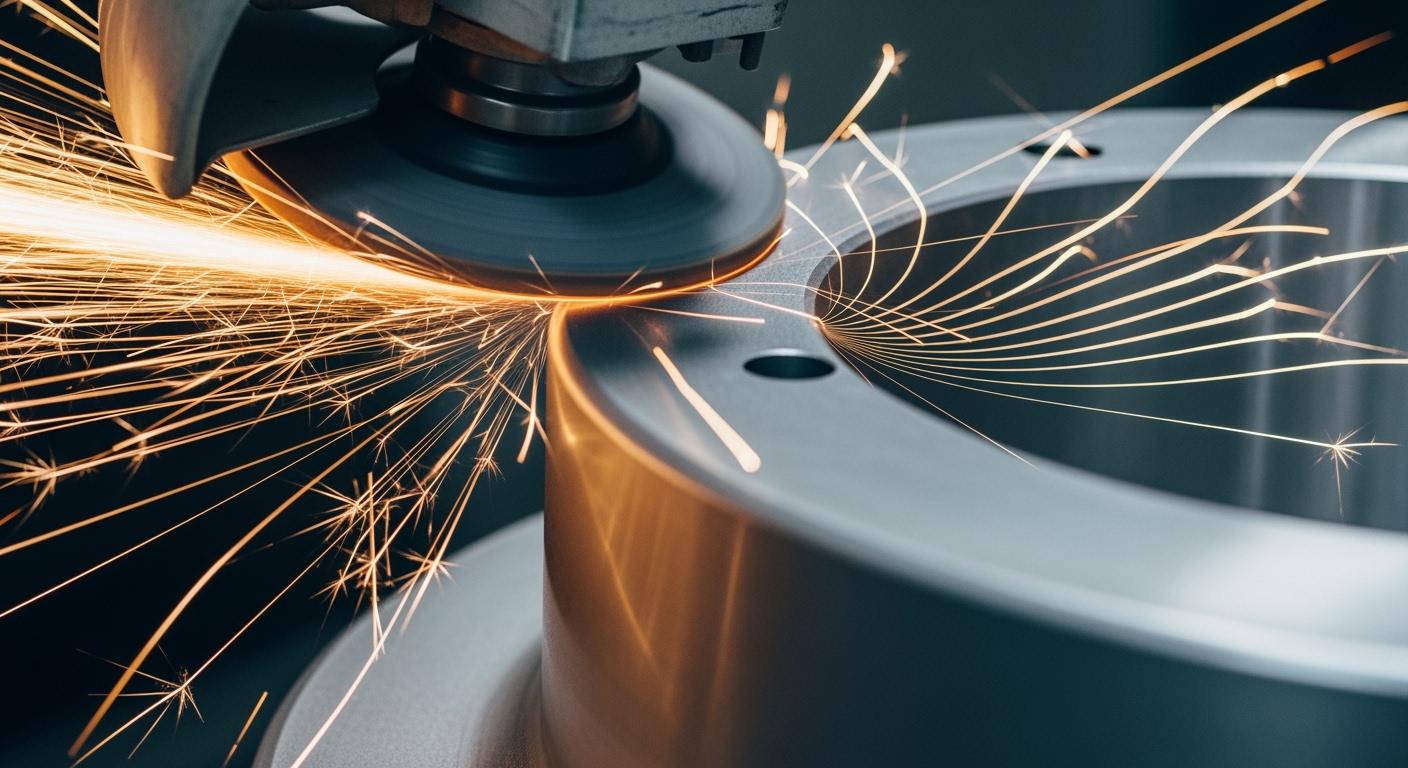
You avoid cracking in superalloy grinding by managing process control and choosing the right materials. Process control lets you adjust grinding parameters. This helps reduce residual stress and improves surface quality. Aimgrind super hard abrasives give you reliable performance. You achieve better results with careful material selection and proper cooling.
- Robotic belt grinding adjusts parameters to optimize surface properties.
- Residual stress affects corrosion and cracking rates during grinding.
Key Takeaways
- Choose Aimgrind super hard abrasives for grinding superalloys. These wheels maintain sharpness and reduce overheating, helping to prevent cracks.
- Control grinding parameters like feed rate and depth of cut. Keeping the depth at 0.12 mm or less lowers residual stress and extends part life.
- Use effective cooling methods, such as high-pressure cooling, to reduce friction and temperature. This helps relieve residual stress and prevents cracking.
Causes of Cracking in Superalloy Machining
Thermal Stress and Overheating
You see thermal stress as one of the main causes of cracking in superalloy machining. When you grind or cut superalloys, uneven temperature distribution can lead to cracks. Thermal fatigue happens when parts heat up and cool down many times. This process creates strains and stresses that start cracks at grain boundaries and phase interfaces. Overheating can make things worse. If you work above or below the recommended temperature limits, you risk cracking. For example, overheating at 800 °C can cause microcracks and reduce the ductility of the alloy.
- Thermal fatigue affects high-temperature parts like those in aero engines.
- Cracks often begin at grain boundaries and slip bands.
- Overheating leads to grain coarsening and loss of ductility.
Mechanical Overload
Mechanical overload is another main cause of cracking. If you apply too much force during machining, the material cannot handle the stress. You may see cracks form quickly. Always check the load limits for your equipment and superalloy type. Using the right grinding wheel, such as Aimgrind super hard abrasives, helps you avoid cracking by reducing mechanical stress.
Inadequate Cooling
Inadequate cooling increases the risk of residual stress and cracking. The difference in thermal expansion between the abrasive layer and the substrate can cause cracks, especially during high-temperature machining. You need to use proper cooling methods to keep temperatures low and protect the surface. The table below shows how different cooling rates affect superalloy properties:
| Cooling Method | Cooling Rate | Hardness | Yield Strength | Elongation |
|---|---|---|---|---|
| Water Quenching | 400 °C/s | 400 HV | N/A | N/A |
| Air Cooling | 1.5 °C/s | 384 HV | 960 MPa | 8.5% |
| Furnace Cooling | 0.1 °C/s | 364 HV | 771 MPa | 13.5% |
Material Selection and Preparation
Material selection and preparation play a big role in avoiding cracking. You should use pre-machining treatments to make the superalloy stronger and less likely to crack. Induction preheating at 800–1100 °C helps dissolve large precipitates and prevents hot cracking. Friction stir processing creates a microstructure that resists liquation cracking. These steps help you prepare the material for safe machining.
| Treatment Type | Description |
|---|---|
| Induction Preheating | Preheating at 800–1100 °C dissolves large precipitates and prevents hot cracking. |
| Friction Stir Processing (FSP) | FSP develops a liquation-resistant microstructure, reducing liquation cracking in IN738 superalloy. |
Tip: Always follow recommended temperature limits and use proper cooling to avoid cracking during machining.
Grinding Wheel Selection for Avoid Cracking
Choosing the right grinding wheel is one of the most important steps you can take to avoid cracking in superalloy machining. The wheel you select affects the temperature, force, and surface finish during grinding. If you want to achieve a smooth surface and reduce the risk of cracks, you need to match your grinding wheel to the properties of the superalloy you are working with.
Choosing Aimgrind Super Hard Abrasives
You should start by selecting Aimgrind super hard abrasives for your grinding tasks. These wheels use diamond and cubic boron nitride (CBN) grains. These materials are much harder than conventional abrasives. They keep their sharpness for a long time and help you maintain a consistent surface quality. When you use Aimgrind super hard abrasives, you get a wheel that can handle high temperatures and tough materials. This helps you avoid cracking because the wheel cuts efficiently and does not overheat the workpiece.
Aimgrind offers a wide range of wheel types and sizes. You can find the right wheel for your specific application. The advanced design of these wheels also improves chip clearance and coolant flow. This means you can keep the grinding zone cool and protect the surface from thermal damage. You get a better surface finish and reduce the chance of cracks forming.
Tip: Always use Aimgrind super hard abrasives when you need to avoid cracking and achieve a high-quality surface on superalloys.
Matching Bond Types to Application
The bond type in your grinding wheel plays a big role in how the wheel performs. You need to choose the right bond to avoid cracking and get the best surface results. The bond holds the abrasive grains together and affects how the wheel wears down.
- Vitrified bonds are made from glassy, ceramic materials. These bonds are strong and rigid. Their porosity helps coolant reach the grinding zone and clears away chips. This is very important for superalloys, which have low thermal conductivity. If you use a vitrified bond, you can keep the surface cooler and reduce the risk of cracks.
- Resin bonds are softer and can be used for high-speed grinding. They provide a smooth surface but may not handle high temperatures as well as vitrified bonds.
- Metal bonds are very durable and work well for precision grinding. They can help you achieve a fine surface finish on hard materials.
You can see the main properties of vitrified bonds in the table below:
| Property | Description |
|---|---|
| Thermal Stability | Vitrified bonds can handle higher temperatures without degrading. |
| Rigidity | They keep their shape for a long time, which is important for grinding complex shapes. |
| Resistance to Softening | Vitrified bonds do not soften at high temperatures, making them good for high-speed grinding. |
When you match the bond type to your application, you help avoid cracking and improve the surface quality of your superalloy parts.
Wheel Grit and Size Optimization
The size of the abrasive grit in your grinding wheel affects the surface finish and the risk of cracks. If you use a wheel with smaller grit sizes, you get a smoother surface and lower residual stress. This is important because a smooth surface resists crack formation and improves fatigue life.
- Smaller grit sizes create a finer surface and reduce the thickness of the white etching layer. This layer can be a weak spot where cracks start.
- Finer abrasives also help you avoid cracking by lowering the amount of heat and stress on the surface.
- If you use a wheel that is too coarse, you may see rough surfaces and higher residual stress. This can lead to cracks and lower part quality.
You should also pay attention to wheel wear. A wheel that is worn in a controlled way can actually improve surface integrity. Samples ground with normally worn wheels often show better fatigue performance because the surface is smoother and less stressed.
Note: Always check the grit size and condition of your grinding wheel before starting. This helps you avoid cracking and get the best possible surface finish.
When you combine the right abrasive material, bond type, and grit size, you can avoid cracking and achieve a high-quality surface on your superalloy parts. Aimgrind super hard abrasives give you the tools you need to meet these goals. You get a reliable solution for tough grinding jobs and can trust your parts to have a strong, crack-free surface.
Process Parameter Optimization in Machining
Feed Rate and Depth Control
You need to pay close attention to feed rate and depth of cut when grinding superalloys. Adjusting the feed rate changes how cracks start and grow. A higher feed rate increases the time before cracks begin and slows their growth. This means your parts last longer and resist fatigue. You should also control the depth of cut. If you increase the depth from 0.06 mm to 0.12 mm, you see a drop in residual stress intensity. However, going above 0.12 mm causes a sharp rise in stress, which can lead to cracks. Try to keep your depth of cut at 0.12 mm or less.
- Increasing depth from 0.06 mm to 0.12 mm lowers residual stress.
- Residual stress drops from 2070 MPa to 2046 MPa at 0.12 mm.
- Depths above 0.12 mm, like 0.2 mm, raise residual stress to 2753 MPa.
- A depth of 0.12 mm is safer for minimizing stress.
Tip: Adjust feed rate and depth carefully to improve fatigue life and reduce cracking.
Wheel Speed Adjustment
Wheel speed affects grinding force, plastic deformation, and thermal stress. When you increase wheel speed, grinding force drops and plastic deformation becomes less. This helps prevent cracks. Faster speeds also remove material quicker and reduce subsurface damage. However, higher speeds raise grinding temperatures, which can cause microcracks and oxidation. You must balance wheel speed to avoid thermal damage.
| Finding | Description |
|---|---|
| Grinding Force | Higher speed lowers force and mechanical load. |
| Plastic Deformation | Less deformation at higher speeds. |
| Material Removal | Faster removal, less subsurface damage. |
| Thermal Damage | Higher speed increases temperature, risk of microcracks and oxidation. |
| Surface Integrity | Careful control needed to protect surface quality. |
Dressing Frequency
You should dress your grinding wheel often. Dressing keeps the wheel sharp and clean. A sharp wheel cuts better and produces less heat. This lowers the risk of cracks and improves surface finish. Regular dressing also helps you maintain consistent grinding performance. You get better results and longer tool life.
Note: Set a dressing schedule based on your grinding conditions and material type. Consistent dressing supports crack-free machining.
Cooling and Lubrication for Residual Stress Relief
Coolant Selection and Application
You need to choose the right coolant for effective cooling and stress relief during superalloy grinding. High-pressure cooling works best because it lowers both friction and temperature. This reduces the risk of cracks and helps with residual stress relief. The table below shows how different cooling methods affect residual stress and surface quality:
| Aspect | High-Pressure Cooling Benefits |
|---|---|
| Friction Reduction | Reduces friction in tool–chip contact area |
| Cutting Force | Decreases cutting force |
| Heat Transfer | Increases heat transfer coefficient |
| Residual Stress Reduction | Lowers surface residual stress |
You should use coolants with high flow rates and pressure. This helps the coolant reach the grinding zone and remove heat quickly. Curved-channel nozzles improve cooling by increasing jet speed and making cooling more uniform. Sensors that control pressure and flow help you keep the temperature low, which is key for stress relief.
Lubrication Techniques
Lubrication supports cooling and stress relief by reducing friction. You can use Minimum Quantity Lubrication (MQL), solid lubricants like graphite, or nano-cutting fluids. These methods help you keep the grinding area cool and protect the tool. Cryogenic cooling with liquid nitrogen or carbon dioxide also works well for stress relief. The table below compares different lubrication techniques:
| Technique | Benefits |
|---|---|
| Minimum Quantity Lubrication | Less fluid, good surface quality |
| Solid Lubricants (Graphite) | Better tool life with oil in MQL |
| Cryogenic Cooling | Lowers temperature, improves tool life |
| Nano-Cutting Fluids | Enhances machinability and tool performance |
Monitoring System Performance
You need to monitor your cooling and lubrication systems to prevent cracks. Real-time sensors help you track temperature and coolant flow. If you see a rise in temperature, you can adjust the cooling system right away. The table below shows how different cooling methods affect temperature and cracks:
| Cooling Method | Effect on Temperature and Cracks |
|---|---|
| Dry Condition | High temperature, more cracks |
| Flooded Coolant Condition | Better heat control, fewer cracks |
| Minimum Quantity Lubrication | Lower thermal damage, good surface finish |
| Cryogenic CO₂ | Efficient heat absorption, less thermal stress and cracks |
By using the right cooling and lubrication methods, you achieve stress relief and protect your superalloy parts from damage. Good system monitoring ensures you get the best results for residual stress relief.
Material Preparation to Avoid Cracking
Pre-Grinding Inspection
You need to inspect superalloy components before grinding. Use advanced methods like eddy current, ultrasonic, and thermographic techniques. These tools help you find cracks and weak spots early. Surface profiling lets you predict crack initiation sites by checking surface roughness. You can spot changes before cracks appear. This step improves reliability and reduces cracking in nickel alloy welding.
Surface Cleaning
You must focus on material preparation and cleaning. Remove dirt, oil, grease, and corrosion from all surfaces. Clean surfaces help you avoid defects during nickel alloy welding. Use clean abrasives and keep stainless steel separate from carbon steel. This prevents iron contamination. Good material preparation and cleaning lowers the risk of cracking in nickel alloy welding.
Tip: Always check for moisture and let weldments reach ambient temperature. This protects the surface and improves weld quality.
Pre-Treatment for Nickel Alloy Welding
You should follow key steps for pre-treatment in nickel alloy welding:
- Select crack-resistant filler metals for strong grain boundaries.
- Use open joint designs to lower residual stress.
- Avoid unnecessary pre-heating to prevent microstructure issues.
- Keep interpass temperature below 150°C (300°F) to protect the heat-affected zone.
| Step | Benefit |
|---|---|
| Crack-resistant filler metal | Better chemistry, fewer cracks |
| Open joint design | Less restraint, lower stress |
| No extra pre-heating | Stable microstructure |
| Low interpass temperature | Protects heat-affected zone |
You improve weld quality and reduce cracking in nickel alloy welding by following these steps. Material preparation and cleaning play a big role in every stage.
Post-Grinding Stress Relief Methods
After you finish grinding superalloys, you need to focus on stress relief. This step helps you prevent stress relaxation cracking and improve the durability of your parts. You can use several methods to reduce residual stress and make your superalloy components stronger.
Heat Treatment for Residual Stress Relief
Heat treatment is one of the most effective ways to relieve residual stress after grinding. You use controlled heating and cooling to change the microstructure of the superalloy. This process lowers stress levels and helps you avoid stress relaxation cracking.
You can see how heat treatment parameters affect residual stress in the table below:
| Heat Treatment Temperature (°C) | Duration (h) | Residual Stress (MPa) | Reduction (%) | Elongation (%) |
|---|---|---|---|---|
| 400 | 2 | 356.29 | 53.7 | 40.2 |
| N/A | N/A | 769.27 | N/A | 26.48 |
You achieve the best results when you use the right temperature and time. For example, heating at 650 °C improves the fatigue limit of notched specimens to 638 MPa. This is a 116% increase over untreated specimens. You also see that this treatment surpasses the performance of SP-treated counterparts by 43%. High-energy impact treatment at 650 °C eliminates stress concentration sensitivity. The fatigue strength of treated specimens matches that of smooth specimens, showing effective stress relief.
Tip: Always monitor the heat treatment process to avoid overheating. Proper control prevents stress relaxation cracking and keeps residual stress low.
You can also use heat treatment aging to stabilize the microstructure. This step helps you maintain the mechanical properties of the superalloy and reduce residual stress over time.
Shot Peening and Hammering
Shot peening and hammering are mechanical methods you can use to relieve residual stress. You bombard the surface with small steel balls or use controlled hammering. This creates tiny dents and compressive stress on the surface. The compressive stress helps you counteract tensile residual stress and prevent stress relaxation cracking.
You follow these steps for shot peening:
- Select the right shot size and intensity for your superalloy.
- Cover the entire surface evenly.
- Monitor the process to avoid excessive surface damage.
You use hammering for larger parts or areas that need extra stress relief. Both methods help you improve fatigue strength and reduce the risk of cracks.
Note: Shot peening works best when you combine it with heat treatment. You get a stronger surface and lower residual stress.
You see that shot peening increases the fatigue limit and helps you avoid stress relaxation cracking. You also notice that hammering can be useful for parts with complex shapes.
Surface Finishing with Aimgrind Tools
Surface finishing is the final step you need to take for stress relief. You use Aimgrind super hard abrasives to polish and finish the surface of your superalloy parts. These tools help you remove microcracks and smooth out rough areas. You achieve a superior surface quality and lower residual stress.
Aimgrind super hard abrasives use diamond and CBN grains. These materials are very hard and durable. You get a consistent finish and avoid overheating. The advanced design of Aimgrind tools improves chip clearance and coolant flow. You protect the surface from thermal damage and reduce the chance of stress relaxation cracking.
You follow these steps for surface finishing:
- Choose the right Aimgrind abrasive tool for your material.
- Set the finishing parameters to match the superalloy properties.
- Monitor the surface quality during finishing.
Tip: Use Aimgrind super hard abrasives for the final polishing step. You achieve a crack-free surface and minimize residual stress.
You see that surface finishing with Aimgrind tools gives you a reliable solution. You improve the fatigue life of your parts and avoid stress relaxation cracking. You also notice that the superior surface quality helps you meet industry standards.
| Step | Benefit |
|---|---|
| Aimgrind tool selection | Matches material and process needs |
| Parameter optimization | Reduces residual stress and microcracks |
| Surface monitoring | Ensures high-quality, crack-free finish |
You combine heat treatment, shot peening, and surface finishing to achieve the best results. You lower residual stress, prevent stress relaxation cracking, and extend the life of your superalloy components.
Remember: Each method plays a role in stress relief. You need to use them together for maximum effectiveness.
Troubleshooting Cracking and Residual Stress
Identifying Signs of Cracking
You need to check the workpiece surface often. Look for tiny lines, rough patches, or changes in color. These signs show early cracks. You can use a magnifying glass or a simple flashlight to spot them. Sometimes, you see small chips or flakes on the workpiece surface. These are warning signs. If you notice any of these, you must act quickly. Regular inspection helps you catch problems before they grow.
Immediate Corrective Actions
When you find cracks, you should stop the grinding process. Clean the workpiece surface and check the grinding wheel for wear. Adjust the feed rate and wheel speed. Use stress management techniques like lowering the grinding force or increasing coolant flow. These steps help you reduce heat and stress. You can also dress the grinding wheel to keep it sharp. Follow crack prevention steps such as checking coolant levels and using Aimgrind super hard abrasives. Quick action keeps the workpiece surface safe and prevents more damage.
Tip: Always keep a checklist for troubleshooting cracks. This helps you remember each step and avoid mistakes.
Long-Term Process Improvements
You can improve your process by using stress management techniques every day. Keep records of crack prevention steps and update them as you learn. Train your team to inspect the workpiece surface and use troubleshooting cracks methods. Try new grinding wheels and adjust parameters for better results. Review your cooling and lubrication systems often. Use Aimgrind super hard abrasives for consistent quality. These actions help you build a strong routine and protect your workpiece surface from future cracks.
| Improvement Area | Action |
|---|---|
| Inspection Routine | Daily checks |
| Training | Teach crack prevention steps |
| Equipment Upgrade | Use Aimgrind abrasives |
| System Review | Update stress management |
You can avoid cracking and reduce residual stress by choosing the right grinding wheel, controlling process parameters, and using effective cooling. Aimgrind super hard abrasives help you achieve a smooth, strong surface.
Quick Checklist:
- Inspect materials
- Select Aimgrind abrasives
- Set correct parameters
- Monitor cooling
- Check for cracks
FAQ
What is the best way to avoid cracking during superalloy grinding?
You should use proper preheating and cooling practices. This reduces residual stress and helps you achieve crack-free welds. Always follow recommended preheating temperatures for high-temperature environments.
How do you prevent residual stress and cracking in welds?
You can use surface strengthening processes and repair and prevention methods. Preheating and cooling practices help you control welding residual stresses. This leads to crack-free welds and longer-lasting parts.
Why are preheating and cooling practices important for crack-free welds?
Preheating lowers the risk of cracking. Cooling at the right rate protects welds from residual stress. You get stronger, crack-free welds with these steps.
Contact Us
For More Grinding Solution or Customized Abrasive Tools