

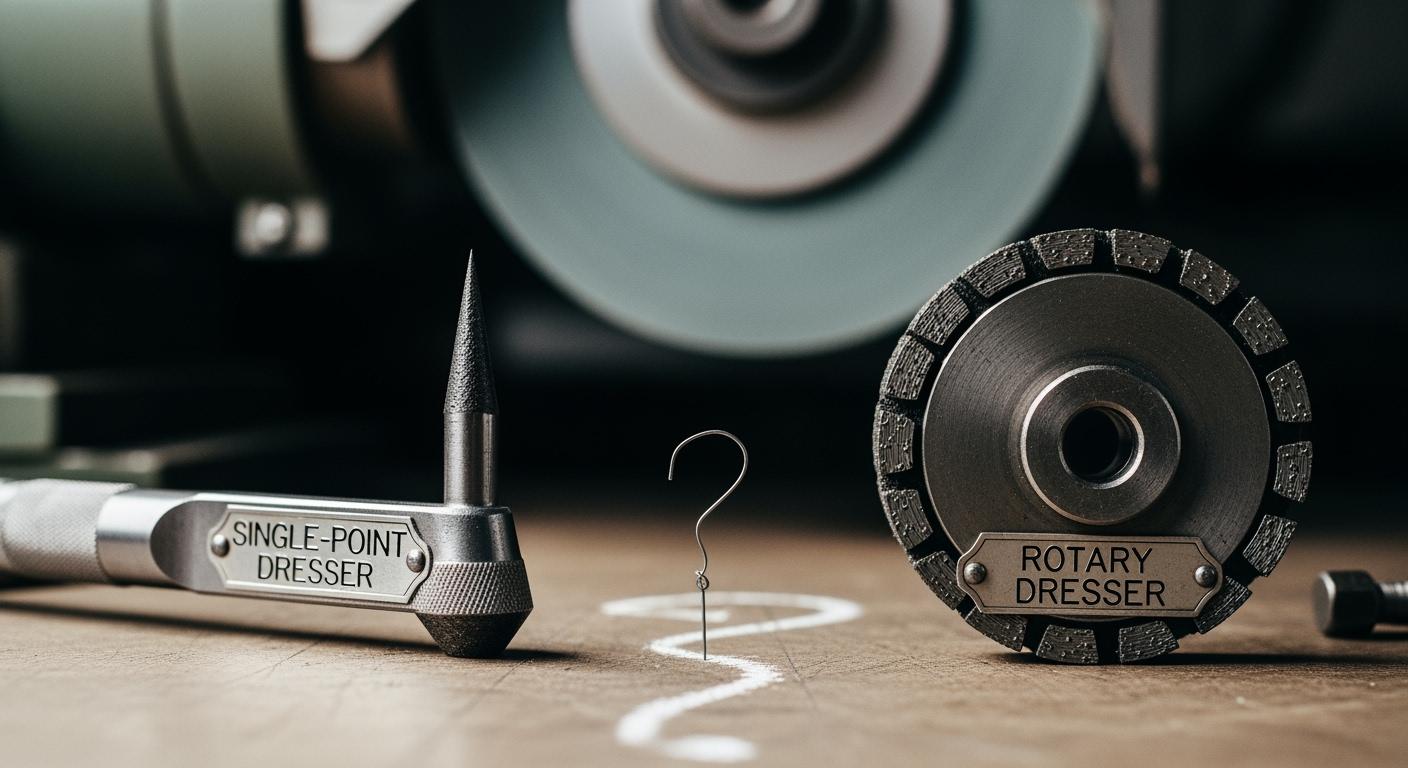
When starting your grinding tasks, you often face a choice between single-point vs rotary dressers. If you handle low-volume dressing or require sharp, precise surface finishes, single-point diamond dressers are an excellent choice. On the other hand, rotary diamond dressers are ideal for high-volume dressing and automated grinding operations. Your best option will depend on the type of dressing, the tools you utilize, and the specific demands of your grinding operations. Consider these key factors before selecting a dresser:
| Key Factor | Description |
|---|---|
| Production Volume | High-volume or low-volume dressing will influence which dresser you choose. |
| Precision Requirements | Certain grinding operations necessitate more precise dressing. |
| Budget Considerations | Evaluate cost, efficiency, and the longevity of your tools. |
By aligning the dressing tool with your needs, you can make the best decision.
Key Takeaways
- Single-point diamond dressers are best for low-volume tasks and precise surface finishes. They are cost-effective and easy to use.
- Rotary diamond dressers excel in high-volume and automated grinding. They provide consistent quality and require less maintenance.
- Consider your production volume and precision needs when choosing a dresser. Match the tool to your specific grinding tasks for optimal results.
- Regular maintenance and proper dressing techniques are crucial for achieving high-quality surface finishes. Schedule dressing to keep tools sharp.
- Always balance cost with quality. Investing in the right dressing tool can save money in the long run by reducing downtime and maintenance.
Single-Point vs Rotary Dressers: Quick Comparison
Comparison Table
You can quickly see the differences between single-point vs rotary dressers in the table below. This helps you choose the right diamond dressers for your grinding tasks.
| Aspect | Single-Point Diamond Dressers | Rotary Diamond Dressers |
|---|---|---|
| Performance | Efficient for simple dressing and truing tasks. | Delivers consistent, high-quality surface finishes. |
| Cost | Affordable for basic dressing needs. | Higher cost, suited for automated and high-volume use. |
| Durability | Limited durability; best for smaller-scale operations. | Highly durable; ideal for continuous grinding. |
| Applications | Tool and die operations, manual dressing. | CNC systems, automated setups, complex dressing. |
| Ease of Use | Simple design, easy to use but needs careful alignment. | Designed for automation, less manual intervention. |
| Maintenance | Requires regular replacement of the diamond point. | Lower maintenance due to uniform wear. |
| Dressing Quality | Can leave uneven surfaces if worn or misaligned. | Provides controlled and consistent dressing patterns. |
Key Differences
When you compare single-point vs rotary dressers, you notice several important differences. Single-point diamond dressers use a single diamond point. You can easily use these tools for basic dressing and truing vs dressing vs profiling tasks. Multi-point diamond dresser designs offer more contact points, but single-point dressers focus on precision.
Rotary diamond dressers feature multiple diamond grains. These tools work well in automated environments. You get uniform surface finishes and faster dressing cycles. Rotary dressers integrate with CNC machines and minimize manual work.
You should consider the following when choosing between single-point vs rotary dressers:
- Single-point diamond dressers suit low-volume grinding and manual dressing. You get cost-effective tools for simple jobs.
- Rotary diamond dressers excel in high-volume, automated grinding. You achieve consistent surface quality and reduce maintenance.
- Multi-point diamond dresser options provide more durability and uniform wear. You can use these for complex dressing patterns.
- New technology, like the DM-9CNC Wheel Dressing Machine, allows offline dressing. You can use programmable single diamond or rotary diamond rolls. This improves grinding efficiency and reduces setup time.
Tip: If you need a uniform surface and fast dressing, rotary diamond dressers are your best choice. For precision and simple dressing, single-point diamond dressers work well.
You can match the right diamond dresser to your grinding tools and dressing needs. This ensures you get the best performance and surface quality.
Single-Point Diamond Dresser Explained
What Is a Single-Point Diamond Dresser?
You use a single-point diamond dresser to sharpen and true grinding wheels. This tool has a single diamond tip mounted on a strong shank. The diamond gives you superior hardness and wear resistance. You can rely on this construction for regular industrial use. The single-point design lets you achieve a smooth surface finish with each dressing. You can use this tool for many grinding wheels in metalworking, woodworking, and machining. It works well in tool rooms, machine shops, and production environments where you need precision. You can use it with both manual and CNC grinding machines.
- A diamond dresser sharpens and trues grinding wheels.
- The diamond tip provides high durability.
- You can use it for many types of grinding wheels.
- It fits manual and automated machines.
- You get a smooth surface finish with each use.
Features and Benefits
You will notice several features that make the single-point diamond dresser a top choice for precision dressing tools. The single diamond point allows you to maintain a straight wheel profile. This tool is best for simple dressing tasks. You can use it to keep your grinding wheels flat and sharp. Compared to multi-point dressers, the single-point type focuses on high accuracy and control. Multi-point dressers have more diamonds for heavy-duty jobs, but single-point dressers give you better precision for fine work.
- Single diamond tip for high accuracy.
- Simple design for easy use.
- Best for maintaining straight profiles.
- Ideal for basic dressing tasks.
- Premium precision dressing tools for fine grinding.
Precision Applications in Grinding
You need high accuracy in many industries. The single-point diamond dresser helps you reach micrometer-level tolerances. This level of precision is important for grinding steel, aerospace, automotive, and tool manufacturing. You can trust this tool for premium precision dressing tools in these fields. The table below shows where you use this dresser and the accuracy you can achieve:
| Application Area | Accuracy Level |
|---|---|
| Grinding Steel | Micrometer-level tolerances |
| Aerospace | Micrometer-level tolerances |
| Automotive | Micrometer-level tolerances |
| Tool Manufacturing | Micrometer-level tolerances |
You can use single-point diamond dressers for precision grinding applications that demand dimensional accuracy and a perfect surface profile. These tools help you meet strict industry standards and deliver high-quality results every time.
Rotary Diamond Dressers Overview
What Are Rotary Dressers?
You use rotary diamond dressers to shape and renew grinding wheels. These tools have a rotary design with many diamond grains on the surface. The rotary movement lets you dress the wheel quickly and with high accuracy. You can use these dressers for both simple and complex dressing tasks. Rotary diamond dressers work well with CNC machines and automated systems. You get a tool that can handle tough jobs and keep your grinding wheels in top shape.
| Characteristic | Description |
|---|---|
| Precision | High precision in dressing grinding wheels, especially for complex shapes. |
| Service Life | Long service life, reducing downtime and maintenance costs. |
| Quality Consistency | Maintains consistent quality in mass production. |
| Complexity of Shapes | Trims complex shaped grinding wheels that other methods cannot achieve. |
| Economic Benefits | Offers the best economic benefits in mass production. |
| Profile Production | Produces complicated profiles with high accuracy without further dressing. |
Features and Advantages
You will notice several advantages when you use rotary diamond dressers. These tools give you high correction efficiency. You can trim complex shapes on grinding wheels that single-point dressers cannot handle. The long life of rotary diamond dressers means you spend less time on maintenance and more time on production. You get stable and consistent quality for every surface you dress. This makes rotary diamond dressers a smart choice for anyone who wants to boost productivity and tool life. You can rely on these tools for heavy-duty dressing and precise surface finishes.
Tip: Choose rotary diamond dressers when you need to keep your grinding wheels sharp and your production line running smoothly.
High-Volume and Automated Grinding
You should use rotary diamond dressers for high-volume and automated grinding tasks. These tools work best in factories and workshops where you need to dress many wheels every day. The rotary design lets you automate the dressing process. You get fast, repeatable results with little manual effort. Rotary diamond dressers help you keep up with large orders and strict quality standards. You can trust these tools to deliver perfect surface finishes and extend the life of your grinding wheels. If you want to improve your dressing process and save time, rotary diamond dressers are the right choice.
Choosing the Right Dresser for Grinding
Application and Material Type
You need to match your dressing tool to your grinding application and the material you work with. Each type of dresser works best for certain tasks and materials. The table below helps you see which diamond tool fits your needs:
| Dresser Type | Best For | Advantages | Considerations |
|---|---|---|---|
| Single-Point Diamond | Small grinding wheels, basic operations | Cost-effective, simple to use | Limited for complex shapes |
| Multi-Point | Large-scale operations, industrial use | Durable, consistent finish, heavy loads | Higher initial cost |
| Rotary Diamond | Production environments, precision work | High precision, speed, complex geometries | Requires more expertise |
| Star Dresser | General applications, budget-conscious | Economical, easy maintenance | Less precision than diamond |
You should use a single-point diamond dresser for small wheels and basic grinding jobs. This tool gives you good control and a sharp finish. Multi-point dressers work well for heavy loads and large-scale applications. Rotary diamond dressers are the best choice for production lines and complex shapes. They give you high precision and fast dressing cycles. Star dressers fit general applications where budget matters more than surface quality.
Production Volume and Precision Needs
You must think about how many parts you need to produce and how precise your results must be. The right tool helps you meet your goals for accuracy and surface finish. The table below shows which dresser fits your production and precision needs:
| Dresser Type | Best For | Precision Requirements | Production Volumes |
|---|---|---|---|
| Single-Point | Precision tasks, small grinding wheels, straight lines, basic geometries | High | Low |
| Rotary | Intricate and heavy-duty work, high-frequency operations, large-scale grinding | High | High |
If you work on low-volume jobs and need tight tolerances, choose a single-point diamond dresser. This tool helps you reach high accuracy for each part. For high-volume production or complex shapes, rotary diamond dressers give you both speed and precision. You can use these tools for heavy-duty grinding and automated dressing. They keep your surface finish consistent, even with many parts.
Tip: Always match your dressing tool to your production needs. High-precision dressing tools help you avoid errors and rework.
Cost, Maintenance, and Operator Skill
You should also consider cost, maintenance, and the skill level of your operators. Each tool has different needs in these areas:
- Single-point diamond dressers cost less and are easy to use. You need to rotate the tool often to keep the diamond sharp. This helps you get a smooth surface and extends tool life.
- Multi-point dressers last longer and need less rotation. They work well for rough grinding and heavy loads.
- Rotary diamond dressers cost more but save time in high-volume applications. They need skilled operators for setup and use. These tools require less frequent maintenance and give you stable, high-quality results.
You can save money by choosing the right tool for your job. For example, a bearing manufacturer switched to a high-quality dressing tool and increased tool life from 1 day to 14 days. This change reduced tool use and saved over $20,000 per year.
Aimgrind Solutions with Conventional Bonded Abrasives
You can pair Aimgrind‘s conventional bonded abrasives with both single-point and rotary diamond dressers. These abrasives use strong materials like aluminum oxide and silicon carbide. They work well for many grinding applications, from tool sharpening to surface finishing.
- For precision dressing tools, Aimgrind’s abrasives give you a smooth, accurate surface.
- You can use single-point diamond dressers for fine work and manual grinding.
- Rotary diamond dressers work with Aimgrind abrasives in automated or high-volume settings. You get consistent results and long tool life.
- Aimgrind’s products fit many machines and applications. You can trust them for both simple and complex grinding jobs.
If you want to improve your grinding process, Aimgrind offers expert advice and custom solutions. You can contact Aimgrind for help with choosing the right dressing tool and abrasive for your needs.
Decision Guide: Single-Point vs Rotary Dressers
Step-by-Step Selection Process
You can follow a clear process to choose the right dresser for your grinding needs. Start by thinking about your main goal. Do you want high precision or do you need to finish many parts quickly? Use these steps to help you decide:
- Define your dressing goal. Do you need a smooth surface or a complex profile?
- Check your production volume. Are you working with small batches or large runs?
- Decide on your precision level. Do you need micrometer-level accuracy or is a general finish enough?
- Look at your available tools. Do you have manual machines or automated systems?
- Think about your budget. Can you invest in advanced precision dressing tools or do you need a cost-effective solution?
- Review operator skill. Do your workers have experience with advanced dressing or do they need simple tools?
Tip: If you need high precision and work with complex shapes, rotary dressers are often the best choice. For simple dressing and basic surface finishes, single-point diamond dressers work well.
Flowchart for Dresser Choice
You can use this easy flowchart to match your needs to the right dresser:
Start
  |
  v
Do you need high precision dressing?
  |-- Yes --> Do you have high production volume?
  |             |-- Yes --> Choose Rotary Dresser
  |             |-- No  --> Choose Single-Point Dresser
  |
  |-- No --> Is your dressing task simple?
                |-- Yes --> Choose Single-Point Dresser
                |-- No  --> Choose Rotary Dresser
This guide helps you pick the right tools for your grinding tasks. You can achieve the best results by matching your dressing method to your production needs and precision goals.
Common Mistakes When Choosing Diamond Dressers
Overlooking Application Needs
You might think any diamond dresser will work for your grinding job, but this can lead to poor results. Each dressing task has unique requirements. If you do not consider the application details, you risk choosing the wrong tools. Suppliers need information about your workpiece material, its hardness, your machine type, how much material you want to remove, and the surface finish quality you expect.
- Grinding wheel suppliers rely on detailed application information to recommend the right dresser.
- Important details include the type of material, its hardness, machine type, stock removal amount, and desired surface.
- If you skip these details, you may end up with a dresser that does not fit your needs, causing inefficiency.
Ignoring Precision or Maintenance
You may overlook how important precision dressing tools and regular maintenance are for your process. If you ignore these, your dressing results can suffer. You might see uneven wear, poor surface finish, or even damage to your grinding wheel. Regular dressing keeps your tools sharp and your results consistent. You should also match the dresser to your wheel’s size and type. Using the wrong angle or speed can reduce the effectiveness of your dressing.
Tip: Set a regular dressing schedule and always use the correct angle—usually 10 to 15 degrees. Dress at 50-80% of your wheel’s speed for best results.
Focusing Only on Price
Choosing a dresser based only on price can cost you more in the long run. Cheaper tools may seem like a good deal, but they often wear out quickly and cause more downtime. You might also face higher maintenance costs and risk unexpected tool failure.
| Issue | Explanation |
|---|---|
| Frequent Replacements | Cheaper tools wear out fast, so you buy more over time. |
| Increased Downtime | More tool changes mean your machines stop more often, reducing productivity. |
| Higher Maintenance | Low-quality tools can strain your machines, leading to more repairs. |
| Risk of Unexpected Failure | Inexpensive tools may break suddenly, disrupting your work and possibly damaging equipment. |
Note: Always balance cost with quality and performance. The right dresser helps you achieve a better surface and longer tool life.
You can improve your grinding results by choosing the right diamond dresser for your needs. The decision guide in this article helps you match your dressing tools to your application, material, and precision level. Using proper dressing methods ensures your surface finish meets high standards and reduces costly rework. Aimgrind offers precision dressing tools and expert advice. Reach out for help selecting the best tools and dressing solutions for your process.
FAQ
What is the main purpose of a diamond dresser?
You use a diamond dresser to shape and clean your grinding wheel. This tool helps you keep the wheel sharp and ready for accurate work.
How often should you dress a grinding wheel?
You should dress your grinding wheel when you notice a drop in performance or a rough surface. Regular dressing keeps your results smooth and precise.
Can you use the same dresser for all grinding wheels?
You should match your dresser to the type and size of your grinding wheel. Using the right tool gives you better results and extends the life of your equipment.
What safety steps should you follow when using a diamond dresser?
Always wear safety glasses and gloves. Make sure your machine is off before you set up the dresser. Check that the dresser is secure before you start.
How do you know when to replace your diamond dresser?
You should replace your dresser if the diamond tip looks worn or chipped. A damaged tip can affect your grinding results and may harm your wheel.